How to Drive an Automatic Car
So, you are thinking about driving an automatic car or maybe you just got one and you are feeling a bit nervous about it. That is completely normal. A lot of people worry that automatic transmission is complicated or that they will mess something up. Here is the truth: automatic cars are actually easier to drive once you understand how they work.
Khushi Motors have been around since 2009 and we work with thousands of drivers every year. We have seen people go from being completely anxious about automatics to absolutely loving them within a few days of practice. The real secret is that you just need to understand the basics and then practice a little bit. That’s it.
This guide is going to walk you through everything. How to start the car. How to stop it. How to handle different situations on Kenya's roads..
Understanding Automatic Transmissions
Let me explain what actually happens inside an automatic transmission so you understand why it feels different from a manual.
| Automatic Transmission | Manual Transmission |
| Transmission shifts gears automatically | Driver manually shifts gears |
| Two pedals: accelerator and brake | Three pedals: accelerator, brake, clutch |
| Easier in heavy traffic | Requires constant engagement |
| Better for beginners | Steeper learning curve |
| Smoother acceleration | More control, more work |
In a manual car, you have a clutch pedal that disconnects the engine from the wheels so you can shift gears. You have to time everything perfectly. Too slow and the car jerks. Too fast and you stall the engine. It takes real skill and coordination.
An automatic car does this work for you. Instead of a clutch, it uses something called a torque converter. This is basically a fluid coupling that smoothly connects and disconnects the engine from the wheels automatically. When you press the accelerator, sensors tell the transmission you need more power so it automatically shifts to the right gear. When you slow down, it shifts back down. All of this happens without you doing anything.
Why does this matter for driving in Kenya? Because our traffic is unpredictable. In Nairobi during rush hour, you might be stopped for ten seconds then moving at full speed then stopped again. With a manual car, your leg would be completely exhausted from the constant clutch work. Your concentration would be on gear changes instead of on the crazy matatu drivers around you. With an automatic, you just press brake and go. Simple. Your brain stays focused on the actual road.
Before You Start: Pre-Driving Checklist
Before you drive anywhere, you need to spend a few minutes getting comfortable in the car. This takes maybe five minutes and it makes a huge difference.
| Check Point | What to Do | Why It Matters |
| Seat Position | Reach pedals comfortably, back supported | Prevents fatigue, improves control |
| Mirror Adjustment | See behind and beside clearly | Prevents blind spots, increases safety |
| Dashboard Familiarity | Locate gauges and controls | Prevents confusion while driving |
| Gear Shift Location | Know where P, R, N, D are | Prevents accidental gear shifts |
| Seatbelt | Fasten before starting | Critical safety requirement |
Getting Your Seat Right
Sit down and adjust the seat backward and forward until you can reach the pedals comfortably. Your knee should have a slight bend when the pedal is all the way down. Your back should be against the seat with support. Your arms should have a little bend when you are holding the steering wheel. In Kenya where it gets hot, you might adjust this a few times as you settle in. That is fine.
Mirrors Are Your Eyes
Seriously, take time with this. Your side mirrors should show a tiny bit of your car and mostly the road beside you. Your rear-view mirror should show the full windshield behind you. A lot of new drivers do not set their mirrors correctly and then get surprised by cars they cannot see. Spend the time now to get it right. It takes two minutes and it keeps you safe.
Know Your Dashboard
Look around the dashboard. Find the speedometer that shows how fast you are going. Find the fuel gauge that shows how much petrol you have. Find the temperature gauge. Find the headlight switch, wiper controls and air conditioning. In newer cars from 2025 and 2026, some of these might be buttons on the steering wheel or a touchscreen. Get familiar with where everything is. Do this before you start the engine, not while you are driving.
Locate Your Gear Shift
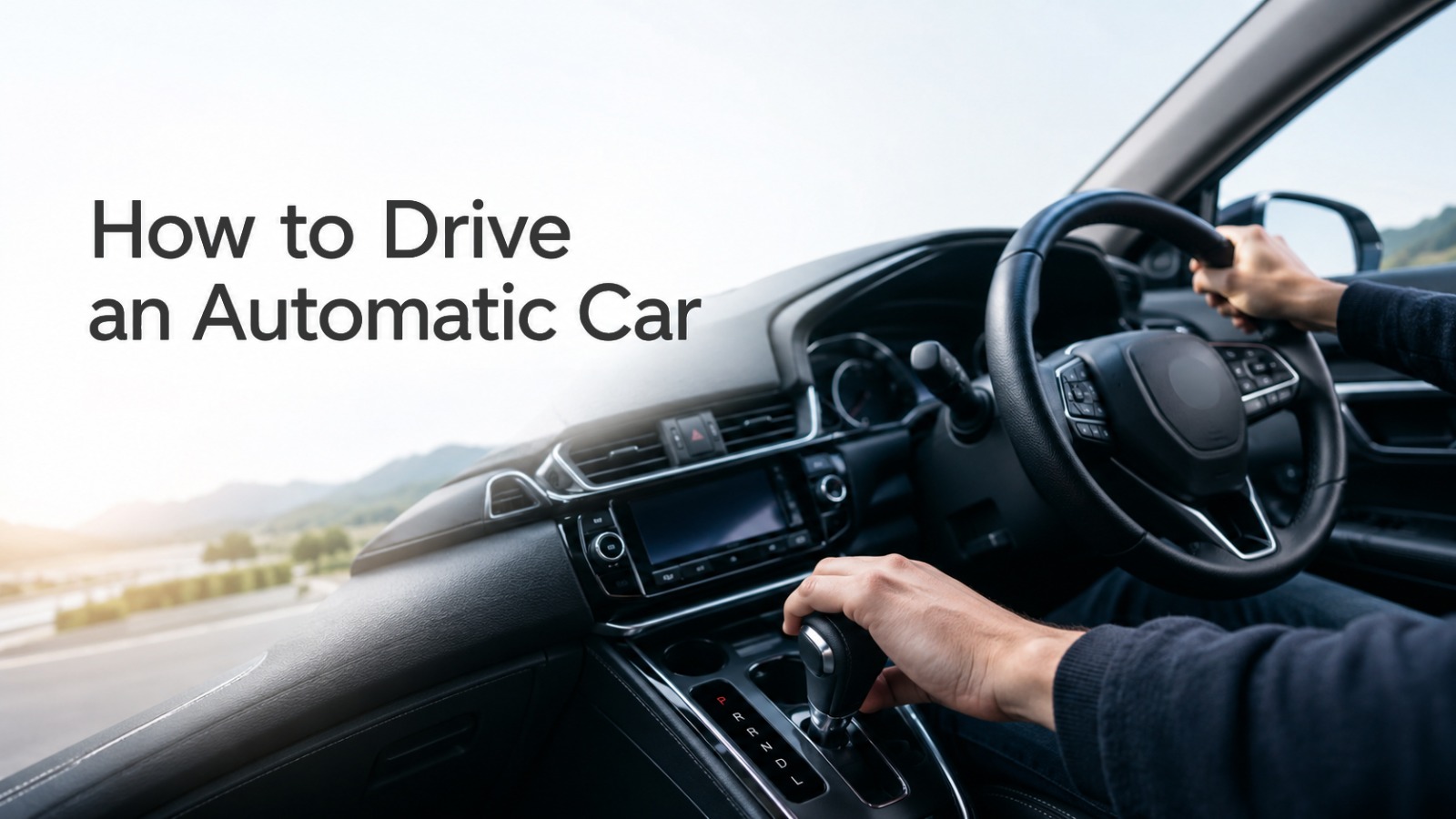
Find the gear shift. This is usually in the middle between the seats. You will see letters like P, R, N and D. Sometimes there is also S or L. We will talk about what these mean in the next section. Some newer automatic cars have the gear shift on the steering column or even buttons on the dashboard. Whatever your car has, find it and understand how it moves.
How to Start and Stop an Automatic Vehicle
Starting Your Automatic Car
This is where people get confused but it is actually super simple.
| Step | Action | Important Details |
| 1 | Press brake firmly | Engine will not start without brake pressed |
| 2 | Insert key or push start button | You will hear the engine run |
| 3 | Check gear shift position | Should be in P (Park) |
| 4 | Shift to D (Drive) | Press button and move lever, or just move it |
| 5 | Check mirrors and path | Make sure everything is clear |
| 6 | Release brake slowly | Foot off brake, not on accelerator yet |
| 7 | Press accelerator gently | Smooth pressure, not sudden |
Here is the thing about starting. Your foot absolutely must be on the brake pedal when you start the engine. This is a safety feature. It prevents the car from accidentally rolling forward. Most automatic cars will not even let you start the engine if your foot is not on the brake. So press that brake firmly.
Now turn the key or push the start button. You will hear the engine start and feel it running. The gear shift should automatically be in P which stands for Park. This locks the transmission so the car cannot roll.
Keep your foot on the brake. Now you need to shift into D for Drive. Depending on your car, you might press a small button on the gear shift before moving the lever, or you might just move it directly. Move it down to D. You should feel or hear it click into place.
Before you take your foot off the brake, check one more time. Seatbelt fastened? Mirrors set? Path ahead clear? Only when you are completely ready should you ease your foot off the brake. Do not press the accelerator while you are releasing the brake. Just let off the brake.
As your foot comes off the brake, the car might start moving forward a tiny bit. This is normal. Do not panic. Now press the accelerator gently. I mean really gently. A small movement. The car will move forward smoothly. A lot of new drivers are nervous and press way too hard. Remember that gentle pressure on the accelerator creates smooth acceleration. Hard pressure creates jerky acceleration.
Stopping Your Automatic Car
Stopping is simple but people have different habits depending on the situation.
| Situation | What to Do | Gear Position |
| Normal stop at traffic light | Press brake pedal smoothly | Stay in D |
| Long stop in traffic jam | Press brake firmly, hold position | Shift to N if stopped more than 10 seconds |
| Parking the vehicle | Come to complete stop | Shift to P |
| Emergency stop | Press brake hard | Stays in D automatically |
When you want to slow down or stop, just press the brake pedal. The more you press, the harder you brake. The transmission will automatically shift down to lower gears as you slow. You do not need to do anything else. Just brake.
At a traffic light, you can stay in D with your foot on the brake. Simple. If you are in heavy traffic and you know you are going to be stopped for a while, you can shift into N for Neutral. This disengages the engine from the wheels so your leg does not get tired holding the brake. But if it is just a quick stop at a light, stay in D.
When you are completely parked and staying there, shift into P for Park. This locks the transmission and prevents the car from rolling. P is only for parking, not for quick stops.
One thing to remember: never shift gears while the car is moving fast. If you are moving at highway speed and need to shift into Reverse, slow down first. The automatic can handle it, but it is rough on the transmission.
Driving Techniques and Safety Tips
How to Drive Smooth
Smooth driving comes from smooth inputs. This means being gentle with the accelerator and brake.
| Technique | How to Do It | Why It Matters |
| Acceleration | Gentle steady pressure | Smooth shifting, good fuel economy |
| Braking | Gradual pressure, anticipate stops | Comfort, brake longevity |
| Steering | Smooth hand movements | Vehicle control, safety |
| Speed adjustment | Ease off accelerator early | Anticipation, smooth transitions |
When you are accelerating, press the accelerator gradually and steadily. Let the transmission do its job. You will feel the car shift gears as it speeds up. This is normal and expected. On highway roads, this feels smooth and nice. In city traffic with lots of stopping and starting, gentle acceleration saves fuel and makes the ride more comfortable for your passengers.
Braking should be smooth too. Press the brake pedal gradually. Do not slam it unless it is an emergency. Smooth braking feels better and is easier on your brakes. In Nairobi where traffic can stop suddenly, try to anticipate stops early. Ease off the accelerator and let the car slow down gradually, then brake smoothly. This is easier than suddenly jamming the brakes.
Driving on Hills
Hills are actually one place where automatic cars are better than manual cars. The transmission does the thinking for you.
| Driving Situation | What Happens | Your Action |
| Uphill on highway | Car automatically downshifts for power | Continue normal driving, accelerate if needed |
| Downhill on steep road | Risk of brake fade from overheating | Use L gear if available, let engine brake |
| Uphill in traffic | Car maintains power automatically | Press accelerator gently as needed |
| Downhill in rain | Increased skidding risk | Reduce speed, use lower gears |
When you are driving uphill, just accelerate as you normally would. The transmission automatically shifts down to lower gears to give you more power. You do not have to think about it. You do not have to select the right gear. It just happens.
When driving downhill on steep hills, here is the trick: use lower gears. Some cars have an L setting or S for Sport mode. Moving the gear shift to L keeps the car in lower gears and uses engine braking to slow you down. This means you do not have to brake as hard and your brakes do not overheat. On long hills, this is much better for the car.
Kenya Roads: What to Watch Out For
| Road Hazard | What to Watch | Safety Action |
| Matatu drivers | Sudden lane changes, aggressive driving | Maintain distance, stay alert, assume they will do something crazy |
| Potholes and rough roads | Suspension damage, loss of control | Reduce speed, watch ahead for hazards |
| Heavy trucks | Limited visibility, possible brake failure | Give plenty of space, never stay in their blind spot |
| Pedestrians and cyclists | Unpredictable movements | Slow down in populated areas, stay alert |
| Night driving | Reduced visibility everywhere | Use headlights, reduce speed, stay focused |
| Heavy rain | Hydroplaning, reduced braking effectiveness | Reduce speed significantly, avoid puddles |
Driving used cars in Kenya is different from driving in other countries. You need to stay alert and focused. Matatu drivers do crazy things. Heavy trucks take up the whole road sometimes. Pedestrians appear from nowhere. Cyclists do not follow rules. Potholes can damage your car.
Because driving an automatic is easier, you might start feeling too confident. Do not let this happen. Stay focused. Keep both hands on the wheel when you can. Do not use your phone while driving. Look ahead and anticipate what other drivers might do.
In 2026, many cars have safety features like automatic braking, blind spot detection and lane departure warnings. Learn what your car has. These features are there to help you.
Test Driving an Automatic Car
If you are thinking about getting an automatic car, test driving one is the best way to see if you like it. Most people feel nervous before a test drive and confident after.
| Test Drive Element | What to Check | What You Are Feeling |
| Acceleration from stop | Smooth or jerky movement | How responsive the transmission is |
| Highway speed | Stability at 80-100 km/h | Engine smoothness and comfort level |
| Braking response | How quickly it stops | Brake system quality and smoothness |
| Gear shifting | Smooth or noticeable transitions | Transmission efficiency and quality |
| Hill climbing | How car handles inclines | Transmission power management |
| Traffic driving | Stop and go patterns | Real world usability and comfort |
Start on quiet roads. Feel how the car accelerates. Notice how smooth the shifts are. Try braking gently and firmly so you understand how responsive the brakes are.
Pay attention to how the car feels. Does it make unusual noises when shifting? Does it feel jerky or smooth? How does it turn? In Kenya, if you can, drive on different road surfaces. Smooth tarmac feels different from rough or potholed roads.
Drive in traffic if possible. This is where you really see the benefit of automatic transmission. Sitting in bumper to bumper traffic that you sometimes get in Nairobi or other cities with a smooth automatic is so much better than constantly working a clutch. You feel this immediately and most people love it.
Ask questions about the transmission. Is it a traditional automatic with a torque converter or a CVT which continuously changes ratios? Is it a dual clutch automatic which is becoming common in 2025 and 2026 cars? Each type has slightly different feel. Understanding what you are getting helps you know what to expect.
Frequently Asked Questions
What are the safety tips for beginners driving automatic cars?
Stay focused on the road. Avoid phone distractions completely. Use smooth inputs on the accelerator and brake rather than jerky movements. Keep both hands on the steering wheel when possible. Check your mirrors regularly. Practice on quiet roads before trying busy city traffic. Always wear your seatbelt.
How to start and stop an automatic vehicle correctly?
To start, press the brake pedal firmly and turn the key or push the start button. Shift into D while the brake is still pressed. Release the brake and press the accelerator gently to move forward. To stop, press the brake pedal smoothly. The car slows and stops automatically. Once stopped, you can shift into N if stopping briefly or P if parking permanently.
How to test drive an automatic car before buying in Kenya?
Start on quiet roads to get comfortable. Feel the acceleration and braking response. Drive on highway sections if possible. Try different road conditions like smooth roads and rougher roads if available. Pay attention to how smoothly the transmission shifts. Test the braking in both gentle and firm applications. Try the car in light traffic to experience real world conditions.
What are the costs of automatic car driving lessons in Kenya?
Professional driving instruction varies based on instructor experience and location. Basic lessons typically range from 500 to 1500 Kenya shillings per hour. Some instructors offer package deals for multiple lessons at discounted rates. Always book with qualified instructors who have proper insurance and valid credentials.
What are the best driving instructors for automatic cars in Kenya?
Look for instructors who specialize in teaching automatic transmissions. Check their credentials and customer reviews carefully. Ensure they have proper vehicle insurance and valid driving instruction licenses. Good instructors teach smooth inputs, proper gear management and safety practices specific to automatic cars and Kenya's unique road conditions.
Final Thoughts
Driving an automatic car is a much nicer experience once you understand the basics. Having only two pedals to worry about makes driving less stressful. You can focus on what really matters which is paying attention to the road and other drivers.
Whether you are a first time driver or switching from a manual, the learning curve is really short. Most people feel comfortable within a few days of practice. What seemed scary before becomes normal really quickly.
The key is practice and being patient with yourself. Start on quiet roads. Move to busier areas as you feel confident. Before you know it, you will wonder why you were ever worried about driving automatic.

David Mwangi
Senior Automotive Consultant
David Mwangi has over 10 years of experience in the automotive industry. He specializes in used vehicle evaluations, car buying advice and ownership guidance. His content helps buyers choose reliable vehicles based on budget, fuel economy and long-term maintenance costs.
Ready to Find Your Perfect Car?
Browse our extensive inventory of quality Japanese used cars or contact our team for personalized assistance.