How to Import a Car from Japan to Kenya: Easy Step by Step Guide (2026)
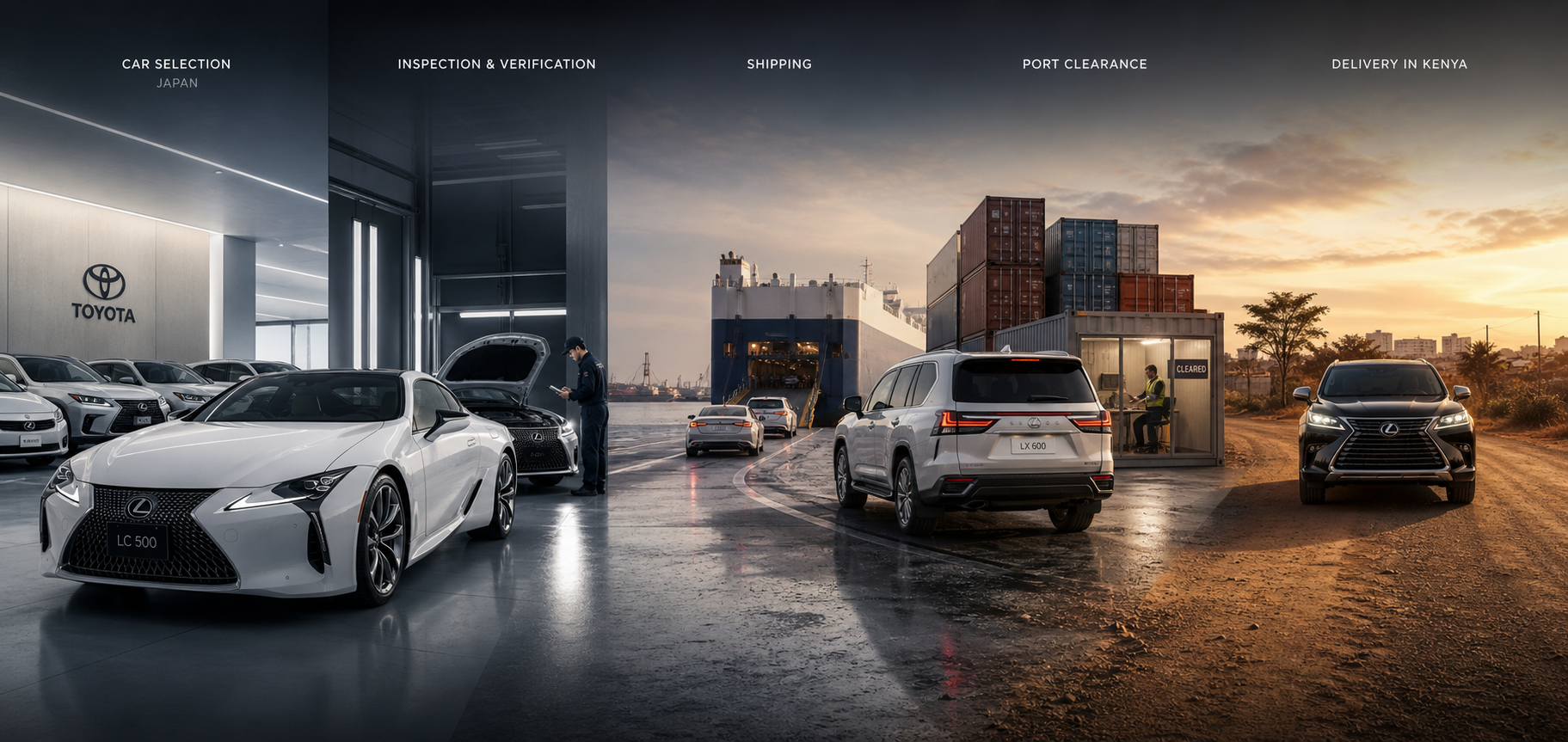
Importing a car from Japan to Kenya is one of the smartest money decisions you can make as a car buyer. A Toyota Premio, Honda Fit, or Subaru Forester from Japan can cost 30 to 40 percent less than buying the same car inside Kenya. And the car will be in much better shape than a locally used one.
But there are steps you must follow correctly. KRA duties, KEBS checks, Mombasa port clearance, shipping, and paperwork can feel overwhelming the first time. This guide breaks every single step down in plain and simple language so you know exactly what to do, what to pay, and what documents you need.
By the end of this guide, you will be able to import your car from Japan to Kenya legally, confidently, and without any expensive surprises in 2026.
Why Do Kenyans Prefer Cars from Japan?
More than 80 out of every 100 used cars imported into Kenya come from Japan. Here is why Japanese cars are so popular:
- The cars are almost new: In Japan, strict government rules called Shaken force people to sell their cars after just 3 to 5 years. So you get a car that still feels and drives like new.
- Good roads mean healthy cars: Japanese roads are smooth and well maintained. Cars there do not suffer from bad suspension, chassis stress, or rust like locally used cars often do.
- Every car has an independent grade: Japan uses auction houses like USS, TAA, and JU. Every car gets a score for its condition from an independent inspector. You know exactly what you are getting.
- You save a lot of money: Buying a Toyota Axio, Nissan X Trail, or Honda Vezel from Japan can save you KSh 300,000 to over KSh 800,000 compared to buying the same model at a local showroom.
- More choices: In Kenya, you can only buy what dealers have in stock. Japan gives you access to thousands of cars in every model, color, and specification level.
Kenya Import Rules You Must Know Before You Start
Before you look at a single car, you need to understand Kenya's import rules. Getting these wrong will cost you a lot of money and time. These rules come from the Kenya Bureau of Standards (KEBS).
Rule 1: The 8 Year Age Limit
Your car must not be more than 8 years old from the date it was first registered. In 2026, this means the car must have been first registered in 2018 or later. Mombasa port will reject any car that is too old, and you will lose both the car and the duty you have already paid.
Watch Out: If your car was first registered in April 2018 and it arrives at Mombasa in May 2026, it is now 8 years old and will be rejected. Always count the age from the actual arrival date at Mombasa, not the date you bought it.
Rule 2: Steering Must Be on the Right Side
Kenya drives on the left side of the road. So every imported car must have the steering wheel on the right. Left hand drive cars cannot be registered in Kenya. Only special purpose vehicles like ambulances or fire trucks are exceptions to this rule.
Rule 3: The Car Must Be Inspected in Japan Before Shipping
Every used car going from Japan to Kenya must be checked by a KEBS approved inspection company before it leaves Japan. The three approved companies are JEVIC, QISJ, and ATJ. Without an inspection certificate from one of these companies, your car will not clear customs at Mombasa. You will also pay a 15 percent penalty on your import duty.
Quick Tip: QISJ records the car's mileage in their database at the time of inspection. This protects you from anyone who may have tampered with the odometer. You can verify the recorded mileage any time after the import.
Rule 4: Extra Care with Cars from Third Countries
Some cars were registered in Dubai, Singapore, or South Africa before being exported to Kenya. These cars need extra paperwork and documentation checks. Importing directly from Japan avoids this complication entirely and makes the process much smoother.
Step by Step: How to Import a Car from Japan to Kenya
Step 1: Decide What Car You Want and Set Your Full Budget
Before you search for any car, be very clear about what you need. Think about all of these things:
- Car make and model: Toyota, Nissan, Honda, Subaru, Mazda, or Mitsubishi
- Year of manufacture: Remember the 8 year rule when importing in 2026
- Engine size: This directly affects how much duty you pay to KRA
- Gearbox type: Automatic or manual
- Fuel type: Petrol, diesel, or hybrid
- How you will use it: Daily commute, family use, business, or ride hailing
- Your total budget: Include the car price, shipping, KRA duties, port charges, and registration fees
Watch Out: A very common mistake is budgeting only for the car price and forgetting that KRA duties and port charges can add 35 to 50 percent on top. Read the full cost breakdown further in this guide before making any decisions.
Step 2: Learn How Japanese Car Auction Grades Work
Most cars imported from Japan come through auction houses. Every car is independently inspected and given a grade. Here is what each grade means:
| Grade | Condition | What It Means for You |
| S or 6 | Almost perfect | Like showroom condition. Extremely rare. |
| 5 | Excellent | No scratches. Real low mileage. Fully working. |
| 4.5 | Very good | Only tiny surface marks. Great mechanical condition. |
| 4 | Good | Small scratches only. Still very reliable. |
| 3.5 | Above average | Some scratches and dents but mechanically sound. |
| 3 | Average | More scratches. Possible minor rust. Needs some attention. |
| 2 or 1 | Poor | Significant damage or rust. Avoid for Kenya road use. |
| R or RA | Accident history | Was in an accident before. Approach with extreme caution. |
The inside of the car is graded separately using letters A through E. A is excellent, E means heavy interior damage. Always aim for Grade 4 and above for reliable use on Kenyan roads.
Quick Tip: Always ask to see the full auction sheet before buying any car. It lists every scratch, dent, and mechanical issue. Make sure you or someone you trust understands how to read it.
Step 3: Choose Your Exporter and Agree on the CIF Price
Once you know exactly what car you want, the next step is finding it. You can either work with a licensed Kenya based importer or try to source directly from a Japanese exporter on your own.
Working with a trusted Kenya based importer means they handle sourcing from Japanese auction networks, verifying the car against the auction sheet, arranging the KEBS approved inspection, managing all shipping documents, and handling Mombasa port clearance. You receive your car with a complete Kenyan logbook.
The price you agree on with the exporter is called the CIF price. CIF stands for Cost, Insurance, and Freight to the Port of Mombasa. It includes the car purchase price, marine insurance (usually 1 to 2 percent of the car value), and the freight cost to ship it to Mombasa. CIF is not your final total cost. KRA duties, port charges, clearing agent fees, and registration are all added on top.
Step 4: Get the Car Inspected in Japan (This is Not Optional)
After payment is confirmed, the car must go to a KEBS approved inspection company in Japan before it is loaded on the ship. The inspector will check:
- That the mileage matches the auction record
- No hidden damage to the car frame or structure
- All lights, brakes, and safety systems are fully working
- No serious rust underneath or on the body
- Tyres are safe to drive on
- Suspension, CV joints, and drivetrain are in good condition
This inspection costs between 19372 KSh and 32287 KSh and takes 3 to 5 working days. Once the car passes, you receive the pre shipment inspection certificate. This document is mandatory for Mombasa port clearance.
Watch Out: If you skip this inspection or try to fake it, KRA adds a 15 percent penalty on your full import duty. That penalty is always far more expensive than the inspection itself.
Step 5: Ship the Car from Japan to Mombasa
Once the inspection is done and the certificate is issued, your car is loaded onto a ship. There are two main ways to ship a car from Japan to Kenya:
| Shipping Method | Cost | Transit Time | Best For |
| RoRo (Roll on Roll off) | Lower | 28 to 45 days | Standard cars. The most common method for Kenya imports. |
| Container Shipping | Higher | 30 to 50 days | Luxury or high value cars that need extra protection. |
RoRo is the most popular method for Kenya imports. The car is simply driven onto the ship in Japan and driven off at Mombasa port. No containers. No complicated loading. Very low risk of damage during transit.
Watch Out: Do not import during Japan's major public holidays. Golden Week in May, Obon in August, and New Year in January all cause shipping prices to jump by 25830 KSh to 51660 KSh. Plan your purchase around these dates.
While the car is on the ship, the exporter sends all original documents to you by DHL courier. You must have these documents before the vessel arrives at Mombasa because your clearing agent needs them to start the customs declaration process. The documents include the Bill of Lading, Export Certificate, Japan Logbook (cancelled), Inspection Certificate, and Commercial Invoice.
Step 6: Clear the Car at Mombasa Port
When the ship arrives at Mombasa port, you have just 4 free days to clear your vehicle. Every day after that costs you money in demurrage charges from the shipping line, plus daily storage charges from the Container Freight Station (CFS) where your car is held.
Watch Out: After the 4 free days, you can pay KSh 5,000 to KSh 15,000 per day in demurrage charges alone. A 2 week delay can add over KSh 100,000 to your total cost. Have your clearing agent briefed and all your documents ready before the ship even arrives.
Here is what happens during Mombasa port clearance:
- Your licensed clearing and forwarding agent submits an Import Declaration Form (IDF) to KRA through the iCMS system.
- KRA assigns a channel: Green means no inspection needed, Yellow means document review, Red means full physical inspection of your car.
- KRA calculates your import duty based on the CRSP system (explained in the next step).
- You pay all duties and taxes through KRA's designated banking channels.
- Once payment is confirmed, KRA releases your car.
- Port handling charges are paid separately to Kenya Ports Authority and the CFS operator.
- Your clearing agent arranges for the car to be transported to your location.
Step 7: Pay KRA Import Duties and Taxes
This is the part that confuses most people and it is also the most expensive part after the car price. KRA does not tax you based on what you paid for the car. They use something called the CRSP, which stands for Current Retail Selling Price. This is the price of that same car brand new in a Kenyan showroom. Your duty is calculated as a percentage of the CRSP, reduced based on the car's age.
Here are the taxes you will pay:
| Tax or Charge | Rate | What It Is Calculated On |
| Import Duty | 25% | Customs Value (CIF price) |
| Excise Duty | Depends on engine size and age | CIF plus Import Duty |
| VAT | 16% | CIF plus Import Duty plus Excise Duty combined |
| Import Declaration Fee (IDF) | 2.25% of CIF, minimum KSh 5,000 | CIF value |
| Railway Development Levy | 1.5% | CIF value |
Quick Tip: Use the car import duty calculator at dutycalc.co.ke before you buy the car. Enter the make, model, year, engine size, and CIF value to get a full estimate. This way you will never be surprised at Mombasa port.
Watch Out: KRA updated its CRSP database in 2026. If you are using an older online calculator, the numbers may be wrong. Always confirm with a current source or speak to a licensed clearing agent.
Step 8: Register the Car at NTSA and Get Your Kenyan Logbook
Once your car is out of Mombasa port, the final step is registering it with NTSA, which is the National Transport and Safety Authority. This gives you a Kenyan logbook and number plates so your car is fully legal on Kenyan roads.
Documents needed for NTSA registration:
- Original Japan Logbook, cancelled and stamped by Japanese authorities
- Pre shipment inspection certificate from QISJ or JEVIC
- KRA duty payment receipts
- Bill of Lading
- Commercial Invoice
- KRA PIN Certificate
- National ID or Passport
- Customs entry document, Form C17
Registration fees vary depending on the engine size and are paid directly to NTSA.
Full Cost Breakdown: What Does It Actually Cost?
Here is a realistic example using a Toyota Premio 2020 (1800cc, petrol) so you can see every single cost clearly:
| What You Pay For | Estimated Cost (KSh) | Notes |
| Car Purchase Price (FOB Japan) | 750,000 to 950,000 | Depends on model, year, and grade |
| Marine Insurance | 7,500 to 19,000 | 1 to 2 percent of FOB. Mandatory. |
| Shipping to Mombasa (RoRo) | 90,000 to 150,000 | Japan to Mombasa |
| Pre Shipment Inspection (JEVIC or QISJ) | 18,000 to 35,000 | KSh 19372 to 32287. Mandatory. |
| Import Duty (25% of CRSP) | Use duty calculator | Based on KRA CRSP 2026 |
| Excise Duty | Depends on engine size | Bigger engine means more duty |
| VAT at 16% | Depends on full taxable value | Applied on the combined taxable amount |
| IDF Fee (2.25% of CIF) | Minimum KSh 5,000 | Paid to KRA on declaration |
| Port Charges (KPA and CFS) | 80,000 to 130,000 | Offloading, storage, and handling fees |
| Clearing and Forwarding Agent Fee | 50,000 to 100,000 | A licensed agent is mandatory |
| NTSA Registration and Number Plates | 10,000 to 30,000 | Depends on engine size |
| Transport to Nairobi if needed | 20,000 to 45,000 | Car carrier from Mombasa |
| Total Estimated Landed Cost | KSh 1.8 million to KSh 2.8 million |
Full Documents Checklist
Missing even one document can get your car stuck at Mombasa port while demurrage charges pile up every day. Here is every document you need:
- Original Japan Logbook, cancelled and stamped by the Japanese vehicle registration authority
- Bill of Lading from the shipping line. Your name must appear as the consignee.
- Export Certificate confirming the car has been taken off Japan's vehicle register
- Pre Shipment Inspection Certificate from QISJ, JEVIC, or ATJ
- Commercial Invoice showing the agreed CIF value
- KRA PIN Certificate
- National ID or Passport copy
- Import Declaration Form (IDF), submitted by your licensed clearing agent
- Marine Insurance Certificate
Quick Tip: All documents from Japan are usually sent to Mombasa by DHL before your car arrives. Make sure you confirm with your exporter that the DHL tracking number is shared with you as soon as documents are dispatched.
Frequently Asked Questions
How long does it take to import a car from Japan to Kenya?
From the day of purchase to delivery at your location, the full process usually takes 45 to 75 days.
Is importing from Japan cheaper than buying locally in Kenya?
For most mid range and higher value cars like SUVs, station wagons, and sedans above KSh 1.5 million, importing from Japan is cheaper than buying locally.
Can I import a car older than 8 years into Kenya?
No. KEBS regulations under Legal Notice No. 78 of 2005 prohibit importing any used car more than 8 years old from the date of first registration. There are no exceptions for private buyers.
How do I calculate my KRA import duty before buying?
Use the car import duty calculator at dutycalc.co.ke. It uses KRA's current CRSP database for 2026. Enter the car make, model, year of first registration, engine capacity, and CIF value to get a full breakdown of what you will owe.
What are demurrage charges and how do I avoid them?
Demurrage is the daily fee the shipping company charges after your vehicle goes past the 4 free days at Mombasa port. CFS storage fees from the Container Freight Station add up separately on top of that. To avoid these charges completely, have your clearing agent ready, your IDF submitted, and all original DHL documents received before the ship arrives.
How to Find a Trusted Importer in Kenya
If you are a first time importer, working with a trusted, Kenya based car importer is the safest and most straightforward option. A good importer will source the car from verified Japanese auction houses, arrange all inspections and shipping, handle every document, clear the car at Mombasa port, and deliver it to you fully registered.
When choosing an importer, look for these signs of a trustworthy company:
- They have a physical showroom or office you can visit in person
- They have been in business for several years with verifiable customer reviews
- They give you a full cost breakdown, including KRA duty, before you pay anything
- They source directly from regulated Japanese auction houses, not through middlemen
- They provide the full auction sheet for any car you are interested in
- They handle KEBS approved pre shipment inspection as standard practice
- They assist with NTSA registration so you get a proper Kenyan logbook
Quick Tip: Ask any importer to show you examples of past auction sheets and import documents before committing. A genuine importer will never hesitate to show you proof of how they work.
How Can I Import a Car Through Khushi Motors?
Importing a car on your own takes time, paperwork, and a lot of back and forth with exporters in Japan. Khushi Motors makes this simple for you.
If you already know what car you want, just tell us the make, model, and year. We check our current stock first. If we have your vehicle available, you can drive it home without waiting. If it is not in stock, we import it directly for you from Japan through our verified auction network.
For example, if you need a Toyota Harrier, Toyota Hilux, or any other specific model, simply contact our team. We find it at the Japanese auction, inspect it, ship it, clear it at Mombasa port, and deliver it to you fully registered. You do not have to deal with a single document yourself.
Why this works for you:
- You tell us what you want
- We search Japan's auction houses on your behalf
- You see the full auction sheet and condition grade before we buy
- We give you the complete cost breakdown including KRA duty before any payment
- Your car arrives at your door with a Kenyan logbook and number plates ready
Whether your choice is in our showroom today or still in Japan, we handle the full process from start to finish.
Ready to Import Your Car from Japan?
Importing a car from Japan to Kenya is one of the best financial decisions you can make as a vehicle buyer in Kenya. When done correctly, you get a well maintained, low mileage car at a price that is 30 to 40 percent less than the local market.
The key is to follow every step in order, prepare your documents before the ship arrives, calculate your KRA duty before you buy, and work with people you can trust throughout the process.
If you want help with any part of this process, Khushi Motors has been importing Japanese vehicles directly into Kenya since 2009. Our team handles everything from auction sourcing in Japan to doorstep delivery in Nairobi, Mombasa, or Kisumu. We give you a complete, honest cost breakdown before you make any payment.
Get a free import consultation and full duty estimate from Khushi Motors.
Also must read: How to Transfer Car Ownership in Kenya (2026 Step-by-Step Guide)

Brian Otieno
Vehicle Import & Logistics Specialist
Brian specializes in vehicle sourcing from Japan and oversees the import process from auctions to final delivery. He writes detailed guides explaining shipping procedures, customs documentation, taxes, and vehicle import regulations across East Africa.
Ready to Find Your Perfect Car?
Browse our extensive inventory of quality Japanese used cars or contact our team for personalized assistance.