Toyota Aqua in Kenya - Prices, Features and Buying Guide
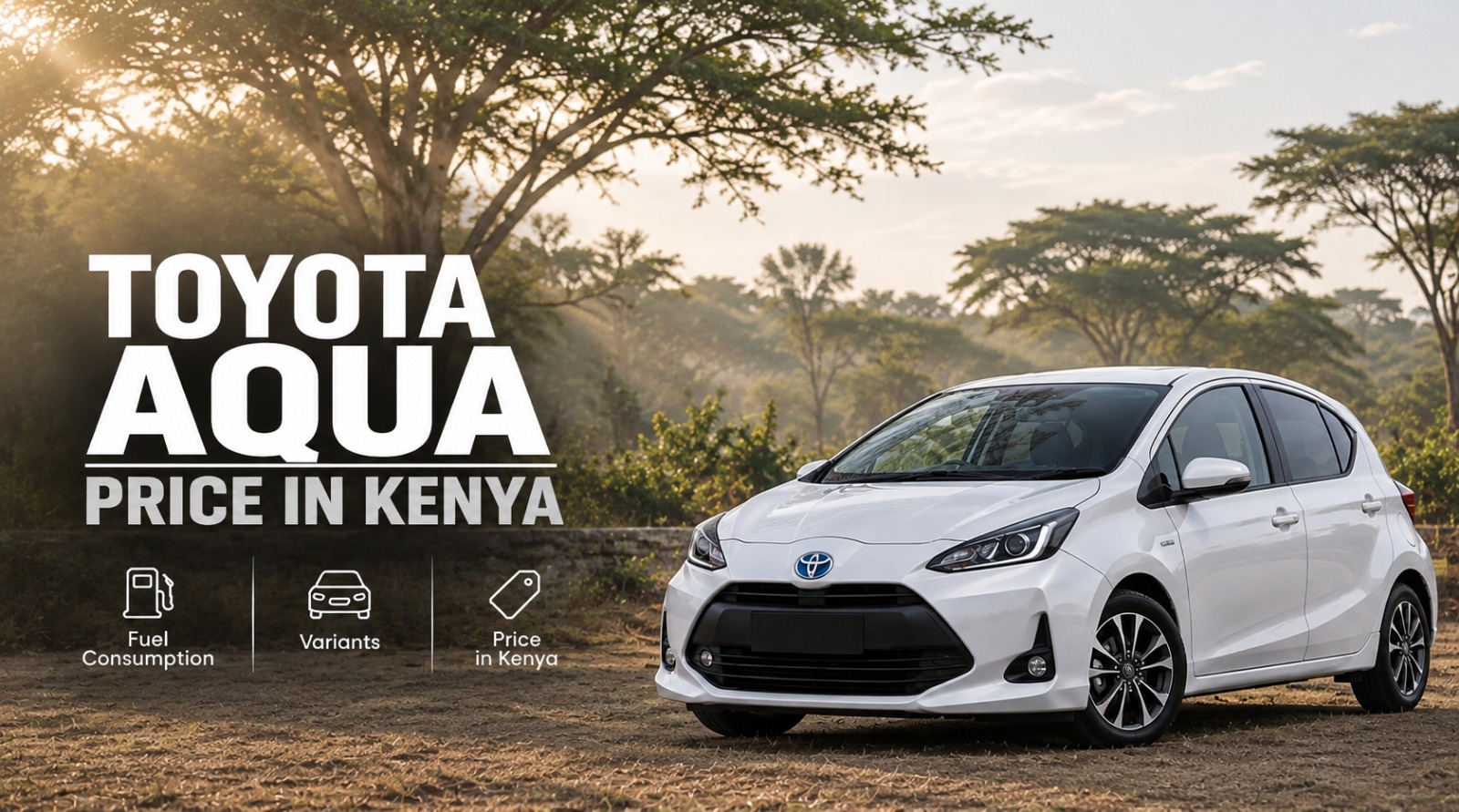
Toyota Aqua is a compact hybrid hatchback with five doors and five seats. Toyota Aqua price in Kenya currently runs from about KSh 900,000 for an older locally used car to about KSh 2.2 million for a clean 2020 unit. Second generation cars cost more. Kenyan buyers choose the Aqua because it uses very little fuel in town and it carries the Toyota name. The price you pay depends on model year, grade, mileage and the condition of the car and its hybrid battery.
Khushi Motors has supplied Japanese used cars to East African buyers since 2009 and this guide answers the questions Aqua buyers ask most. It covers prices by year, grades, fuel consumption, import costs from Japan and what to check before you pay.
Toyota Aqua Quick Facts
| Question | Short Answer |
| Price in Kenya | About KSh 900,000 to 2.2 million for 2015 to 2020 cars |
| Median asking price | KSh 1,450,000 |
| Body and seats | Five door hatchback with five seats |
| Engine | 1.5 litre petrol hybrid |
| Does it need charging? | No. It charges itself while driving. |
| Official fuel figure | 27.2 to 38.0 km/L depending on year and test |
| Realistic fuel use | Roughly 21 to 26 km/L in mixed driving |
| Ground clearance | 140 mm (170 mm on Crossover) |
| Years you can import in 2026 | First registered in 2019 or later |
| Estimated import cost | About KSh 1.39 million to 1.54 million for a 2020 G |
Toyota Aqua Price in Kenya
Most Toyota Aqua cars in Kenya are priced between KSh 1.15 million and KSh 1.9 million. The table below shows the asking price range for each model year.
| Model Year | Version | Can It Still Be Imported in 2026? | Asking Price in Kenya |
| 2015 | First generation with the 2014 update | No. Local stock only. | KSh 900,000 to 1,350,000 |
| 2016 | First generation with the 2014 update | No. Local stock only. | KSh 980,000 to 1,400,000 |
| 2017 | First generation. 2014 or 2017 update depending on the month. | No. Local stock only. | KSh 1,450,000 to 1,665,000 |
| 2018 | First generation with the 2017 update | No. Local stock only. | KSh 1,355,000 to 1,700,000 |
| 2019 | First generation with the 2017 update | Yes | KSh 1,400,000 to 1,850,000 |
| 2020 | First generation with the 2017 update | Yes | KSh 1,770,000 to 2,190,000 |
| 2021 to 2023 | Second generation | Yes | About KSh 2.17 million to 2.59 million |
These are asking prices. They are not final sale prices. The 2021 to 2023 row is an import cost estimate and not a showroom price.
What Your Budget Buys
| Budget | What to Expect |
| Under KSh 1.2 million | A 2015 or 2016 car. Often locally used with higher mileage. |
| KSh 1.2 million to 1.5 million | A cleaner 2016 or 2017 car or a 2018 car with higher mileage. |
| KSh 1.5 million to 1.9 million | A 2018 to 2020 car. This is also the range for importing a 2020 unit. |
| Above KSh 2 million | A 2020 G grade or a second generation car from 2021 onward. |
If you plan to pay in instalments see the Khushi Motors car finance page for the options available.
Why Toyota Aqua Prices Differ
Two cars of the same year can differ by KSh 300,000 or more. These are the main reasons.
• Model year: Newer cars cost more. Cars from 2018 onward also have the updated front design.
• Grade: A G costs more than an S or an L of the same year.
• Condition and accident history: Repainted or repaired cars sell for less.
• Hybrid battery condition: A weak battery lowers the value because the buyer may need to replace it.
• Import status: Foreign used cars with a new number plate usually cost more than locally used cars.
• Demand: The Aqua is popular with taxi app drivers and commuters which keeps prices firm.
• Exchange rates: Import prices move with the yen and the dollar.
Local Stock, Import Offers and Auction Prices Are Not the Same
You will see four kinds of prices online. Do not mix them up.
• Kenyan retail price: The car is in Kenya with duty paid. This is the price you can drive away at.
• Import offer: A dealer quotes a total to bring a car from Japan. Check what the total includes.
• CIF or "duty not paid" price: This covers the car, insurance and shipping to Mombasa only. Taxes and clearing are extra.
• Japanese auction price: This is what the car sold for in Japan. That is roughly KSh 518,000 and it is far below the final Kenyan cost.
Toyota Aqua Price by Model Year
Toyota launched the Aqua in Japan on 26 December 2011. It was sold in some other countries as the Prius c. The first generation stayed on sale until 2021 with two visible updates. The second generation arrived on 19 July 2021.
| Model Version | Model Years | Main Changes |
| First generation | 2012 to 2014 | Original design. L, S and G grades. Official figure of 35.4 km/L which rose to 37.0 km/L in late 2013. |
| Updated first generation | 2015 to 2017 | New bumper and interior trim from December 2014. X-URBAN crossover style grade added. Toyota Safety Sense C offered from November 2015. |
| Second update of first generation | 2018 to 2021 | New front design from June 2017. Slightly longer body. Crossover grade replaced X-URBAN. GR SPORT replaced G's. |
| Second generation | 2021 onward | New platform and new 1.5 litre three cylinder hybrid. Longer wheelbase. Toyota Safety Sense standard. Four wheel drive option. |
Japanese launch dates fall late in the year so a car first registered in 2015 normally has the December 2014 update. A car registered in 2018 normally has the June 2017 update.
There is one important point for buyers in 2026. KEBS only allows used vehicles first registered on or after 1 January 2019 to enter Kenya this year. So every 2015 to 2018 Aqua on sale is already in the country. Only 2019 and newer cars can still be imported.
Toyota Aqua Grades and Their Differences
All first generation grades share the same engine and hybrid system. The differences are in equipment, wheels and trim.
| Toyota Aqua Grade | Main Features | Key Differences |
| L | Entry grade. 14 inch steel wheels at launch. Basic trim. | Lightest and cheapest. Fewer comfort features. Safety Sense C was optional. |
| S | Middle grade. 15 inch steel wheels at launch. Fabric seats. | The most common grade in Kenyan adverts. Safety Sense C was optional. |
| G | Top regular grade. Cruise control from the December 2014 update. | Safety Sense C standard from November 2015. A Soft Leather Selection version was sold. |
| X-URBAN and Crossover | Raised body with black body cladding. | Crossover has 16 inch tyres and 170 mm ground clearance. That is 30 mm more than other grades. |
| G's | Sport version sold from December 2013. | Tuned suspension, stiffer body, 17 inch alloy wheels, special bumpers and sports seats. |
| GR SPORT | Replaced G's in November 2017. Based on the G. | Special bumpers and grille, tuned suspension and sports front seats. A 17 inch package was offered. |
The second generation launched with B, X, G and Z grades. The Z is the top grade and has a 10.5 inch display as standard. A GR SPORT joined later.
Not every grade was sold in every year. An S suits most commuters and first time buyers. A G suits buyers who want more comfort and the safety package. A Crossover is worth a look if you often drive on rough town roads. G's and GR SPORT cars ride lower and firmer so they suit smooth roads best.
Toyota Aqua Specifications and Performance
The Aqua is a full hybrid. A petrol engine and an electric motor share the work. At low speed the motor can move the car by itself. When you accelerate hard both work together. The car has no clutch pedal and no gear steps. It uses an electric continuously variable transmission which changes ratio smoothly.
Toyota Aqua is a self charging hybrid. The engine and the brakes charge the battery while you drive. You never plug it into a charger.
| Specification | First Generation (2012 to 2021) | Second Generation (2021 onward) |
| Engine | 1.5 litre four cylinder petrol | 1.5 litre three cylinder petrol |
| Engine Capacity | 1,496 cc | 1,490 cc |
| Engine Power | 74 PS | 91 PS |
| Electric Motor | 61 PS | 80 PS |
| Combined Power Output | 100 PS | 116 PS |
| Hybrid System | Toyota Hybrid System II with nickel metal hydride battery | Toyota Hybrid System II with bipolar nickel hydrogen battery on all grades except B |
| Transmission | Electric CVT | Electric CVT |
| Drive System | Front wheel drive only | Front wheel drive or E-Four electric four wheel drive |
| Fuel Tank | 36 litres | 36 litres |
PS is a metric measure of power. One PS is almost the same as one horsepower.
The first generation is quick enough for town and steady on the highway. It is not a fast car. Toyota says the second generation battery gives about twice the output of the old one which makes acceleration from low speed smoother.
Toyota Aqua Fuel Consumption in Kenya
Official Toyota Aqua fuel consumption figures come from Japanese laboratory tests. They are useful for comparing cars. They are not what you will get on Thika Road.
| Model and Test | Official Figure |
| 2012 launch model (JC08 test) | 35.4 km/L |
| Late 2013 to mid 2017 (JC08 test) | 37.0 km/L for lighter versions |
| Mid 2017 onward (JC08 test) | 38.0 km/L for L and 34.4 km/L for S, G and Crossover |
| 2020 first generation (WLTC test) | 27.2 to 29.8 km/L |
| Second generation front wheel drive (WLTC test) | 33.6 to 35.8 km/L |
| Second generation E-Four (WLTC test) | 30.0 to 30.1 km/L |
A hybrid is different from a normal petrol car. It often does better in town than on the highway. In slow traffic the electric motor does much of the work and braking recovers energy. At a steady 110 km/h the petrol engine runs almost all the time.
Several things change your result.
• Traffic: Stop and go traffic suits the hybrid system. Long idling with the air conditioning on does not.
• Air conditioning: Heavy use in hot weather raises consumption.
• Driving style: Hard acceleration and late braking waste fuel. Gentle driving can add several km/L.
• Speed and hills: Fast highway driving and long climbs such as the road up from Mai Mahiu use more fuel.
• Car condition: Low tyre pressure, a tired hybrid battery or overdue servicing all reduce economy.
A realistic expectation for a healthy first generation Aqua is somewhere in the low to mid twenties in km/L. Some drivers will do better. No seller can guarantee a figure.
Toyota Aqua Fuel Cost per Month
EPRA set the Nairobi price of super petrol at KSh 226.96 per litre from November to 14 December 2026. The table shows what that means for a driver who covers 1,500 km in a month.
| Car and Fuel Use | Fuel per Month | Cost per Month | Cost per km |
| Toyota Aqua at 22 km/L | About 68 litres | About KSh 15,500 | About KSh 10.30 |
| Small petrol car at 15 km/L | 100 litres | About KSh 22,700 | About KSh 15.10 |
| Larger petrol car at 12 km/L | 125 litres | About KSh 28,400 | About KSh 18.90 |
At these figures the Aqua saves about KSh 7,200 a month against a small petrol car. That is about KSh 86,000 a year. Your saving will change with your mileage, your driving and the pump price.
Toyota Aqua Interior, Exterior and Features
Exterior Features
The Aqua has a low sloping roof that helps it cut through the air. Early cars have a rounded nose. Cars with the June 2017 update have slimmer headlights and a new bumper and bonnet. The second generation looks smoother and the Z grade has LED headlights as standard.
| Dimension | First Generation | Second Generation |
| Length | 3,995 mm (4,050 mm from the 2017 update) | 4,050 mm |
| Width | 1,695 mm | 1,695 mm |
| Height | 1,445 to 1,455 mm | 1,485 mm |
| Wheelbase | 2,550 mm | 2,600 mm |
| Ground Clearance | 140 mm (170 mm on Crossover) | 140 mm on front wheel drive cars |
Wheels range from 14 inch steel on early L cars to 17 inch alloys on G's and GR SPORT cars.
Interior Features
The first generation has a digital instrument display in the centre of the dashboard. From the 2017 update all grades except L have a colour information screen. Seats are fabric on most cars. Air conditioning is fitted but the type of control depends on the grade. Japanese market navigation units often work in Japanese only so many Kenyan owners fit a new radio.
Front seat space is good for a small car. The rear seat suits two adults on short trips or three children. Tall passengers will find rear headroom tight because of the sloping roof. The first generation boot holds about 305 litres. That is enough for weekly shopping or two medium suitcases but not for a large family's luggage. The second generation has a longer wheelbase and more rear legroom.
The Aqua works well for daily commuting and for a small family. It is not a big family car.
Toyota Aqua Safety Features
Safety equipment depends on the model year and grade. Do not assume a car has a feature because another Aqua has it.
• All years: Front airbags, ABS with EBD, Vehicle Stability Control and Traction Control appear in Toyota's specification sheets. Side and curtain airbags depend on grade and options.
• From November 2015: Toyota Safety Sense C became standard on the G and optional on the S and L. It includes pre collision braking, lane departure alert and automatic high beam.
• Second generation: Toyota Safety Sense is standard on every grade. It adds radar cruise control and lane tracing assist. Parking Support Brake and an automatic parking system were also offered.
• Rear camera: This depends on the audio or navigation package fitted in Japan. Check the actual car.
Look for the camera unit at the top of the windscreen to confirm that a first generation car has Safety Sense.
Cost of Importing Toyota Aqua from Japan to Kenya
The Toyota Aqua import cost in Kenya has three parts. These are the cost of the car landed at Mombasa, the government taxes and the private service charges.
Import Eligibility
• Age limit: KEBS applies the eight year rule in standard KS 1515:2000. In 2026 only vehicles first registered on or after 1 January 2019 are allowed in.
• Timing risk: The cut off normally moves forward by a year each January. Confirm the 2027 rule with KEBS before you order a 2019 car late in the year.
• Right hand drive: Only right hand drive vehicles qualify.
• Roadworthiness inspection: The car must be inspected in Japan by QISJ which is the KEBS appointed agent. It then gets a Certificate of Roadworthiness.
• Documents: You need the Japanese export certificate, commercial invoice, bill of lading, inspection certificate, Import Declaration Form, your KRA PIN and your ID.
• Clearing agent: KRA requires a licensed clearing agent to lodge the customs entry.
Import Cost Calculation
KRA does not tax the price on your invoice. For used cars it starts from the Current Retail Selling Price or CRSP. This is KRA's own list price for each model. The current list took effect on 1 July 2025. KRA then removes depreciation for the car's age and works back to a customs value.
Tax rates for a car of 1,500 cc or less:
• Import duty: 35% of customs value.
• Excise duty: 20% of customs value plus import duty.
• VAT: 16% of customs value plus import duty plus excise duty.
• Import Declaration Fee (IDF): 2.5% of customs value.
• Railway Development Levy (RDL): 2% of customs value.
The example below is for a 2020 first generation Toyota Aqua G arriving in 2026. It was calculated on 16 November 2026.
| Cost Component | Amount (KSh) | Calculation Basis |
| Vehicle Purchase | 518,384 | Average 2020 auction price of 637,391 yen at KSh 0.81329 per yen |
| Shipping to Mombasa | 116,928 to 168,896 | RoRo freight of USD 900 to 1,300 at KSh 129.92 |
| Marine Insurance | About 7,776 | About 1.5% of vehicle value |
| QISJ Inspection | 20,138 | USD 155 per unit in the KEBS inspection manual as reported by KMC Japan |
| Customs Valuation | 620,899 | CRSP of 3,241,092 for Aqua G less 55% depreciation then KRA's formula |
| Import Duty | 217,315 | 35% of customs value |
| Excise Duty | 167,643 | 20% of 838,214 |
| VAT | 160,937 | 16% of 1,005,857 |
| IDF | 15,522 | 2.5% of customs value |
| RDL | 12,418 | 2% of customs value |
| Total Government Taxes | 573,835 | Sum of the five taxes above |
| Clearing, Port and Registration | 150,000 to 250,000 | Market range for agent fees, port handling and NTSA plates |
| Estimated Total | About 1,387,000 to 1,539,000 | Vehicle, shipping, insurance, inspection, taxes and local charges |
The customs valuation row is only the base for the taxes. It is not added to the total. This is an estimate and not an official customs assessment.
Points to confirm before you pay:
• Which CRSP line applies: The KRA list has more than one Aqua entry. One S entry carries a higher value and would raise the taxes to about KSh 799,000. Ask your clearing agent which line KRA will use for your exact car.
• Auction price is an average: A low mileage or high grade car will cost more than 637,000 yen.
• Export agent fees and inland transport in Japan: These vary by exporter and could not be verified. Ask for them in writing.
• Port and clearing charges: There is no single official rate card. Quotes in the market range widely.
• NTSA registration: Sources quote different amounts. Check the current fee on the NTSA portal.
• Transport from Mombasa: This is extra if you want the car delivered upcountry.
How to Import Toyota Aqua from Japan to Kenya
1. Choose the model year and grade. Pick 2019 or newer and decide between S, G or another grade.
2. Confirm eligibility. Check the first registration date on the export certificate and not only the advertised year.
3. Find a suitable car. Use a trusted exporter or dealer with access to Japanese auctions and stock.
4. Read the auction sheet. This is the inspection report written at the auction. It shows the overall grade, interior grade, mileage and a diagram of dents, scratches and repairs.
5. Verify mileage and accident history. Compare the auction sheet with the export certificate and photos. An "R" or "RA" grade means the car has been repaired after an accident.
6. Complete the purchase. Pay only against a proper invoice that shows the chassis number.
7. Arrange export documents. The exporter cancels the Japanese registration and books the QISJ inspection.
8. Ship the car. Most cars travel by RoRo vessel to Mombasa. You receive a bill of lading.
9. Clear customs. Your agent lodges the entry and you pay the taxes to KRA.
10. Complete inspections. KEBS and port checks are done before release.
11. Register and collect. The car is registered with NTSA and given number plates. Then it can be driven or transported to you.
Before you send money ask for the auction sheet, clear photos, the export certificate and an invoice with a full cost breakdown. Shipping times change with vessel schedules so treat any arrival date as an estimate.
If you would rather not manage each step yourself the Khushi Motors vehicle import service handles sourcing, shipping, clearance and delivery for you.
Should You Buy a Toyota Aqua Locally or Import One?
A 2020 Aqua S was listed in Kenya at about KSh 1.77 million to 1.89 million. The import estimate above for a 2020 car is about KSh 1.39 million to 1.54 million. If KRA applies the higher S valuation the estimate rises to about KSh 1.61 million to 1.76 million. So importing can save money but the gap is not guaranteed.
| Factor | Buying in Kenya | Importing from Japan |
| Price | Higher asking price but you can negotiate | Often lower but it moves with the yen, the auction and KRA's valuation |
| Model years | 2015 to 2020 and some newer cars | 2019 and newer only |
| Inspection | You can see, scan and test drive the car | You rely on the auction sheet and photos |
| Waiting time | You can drive away once payment and transfer are done | You wait for shipping and clearance |
| Main risk | Hidden local wear or a tampered odometer | Cost surprises at the port or a car that differs from the photos |
Buy locally if you want an older and cheaper car or you want to inspect it first. Import if you want a 2019 or newer car with verified Japanese history and you can wait. Either way ask for a written total that shows every charge.
Khushi Motors offers both routes. You can view cars already in Kenya at its Mombasa and Kisumu locations or order a specific car from Japan.
Toyota Aqua Cars Available at Khushi Motors
Khushi Motors is a KNCCI Award Winner with branches serving Kenya, Uganda and Tanzania.
Stock changes often so check the live Toyota Aqua stock page for current cars. There you can compare each one by model year, grade, mileage, condition and price.
You can also browse all Toyota vehicles in stock or ask the team to source a specific Aqua from Japan for you.
Toyota Aqua Compared with Other Cars in Kenya
The closest rivals are the Toyota Vitz, the Honda Fit Hybrid and the Nissan Note e-POWER. The newer Toyota Yaris Hybrid shares its platform and hybrid system with the second generation Aqua.
| Comparison Factor | Toyota Aqua | Toyota Vitz | Honda Fit Hybrid | Nissan Note e-POWER |
| Fuel Consumption (official) | 35.4 to 38.0 km/L (JC08) | Petrol models reported at 15 to 20 km/L in real use | 36.4 km/L (JC08, 2013 model) | 37.2 km/L (JC08, 2016 model) |
| Engine | 1.5 litre hybrid | 1.0 or 1.3 litre petrol. Hybrid from 2017. | 1.5 litre hybrid | 1.2 litre petrol used as a generator |
| Hybrid Technology | Engine and motor both drive the wheels | None on most cars | Engine and motor with dual clutch gearbox | Electric motor drives the wheels at all times |
| Passenger Space | Tight rear headroom | Similar or smaller | The roomiest of the four | Good rear legroom |
| Boot Space | About 305 litres | About 250 to 270 litres | Larger with flexible folding seats | Varies by version |
| Market Price | KSh 900,000 to 2.2 million | From about KSh 500,000 for older petrol cars | About KSh 1.3 million to 1.9 million (2025 source) | Sources disagree. Check current listings. |
The Vitz is cheaper to buy and simpler to maintain but it uses more fuel. The Honda Fit Hybrid is the practical choice with the most cabin and luggage room. The Note e-POWER feels like an electric car in town. The Aqua's main strength is low fuel use with Toyota hybrid parts that many Kenyan garages now know. If you need space choose the Fit. If your budget is under KSh 900,000 a petrol Vitz is the realistic option. You can compare Toyota Vitz, Honda Fit and Nissan Note stock side by side.
Is Toyota Aqua Suitable for Kenyan Roads?
The Aqua suits tarmac roads in and between towns. It is at its best in city traffic where the hybrid system saves the most fuel. It is small and easy to park. On the highway it is stable at normal speeds and can handle a Nairobi to Mombasa or Nairobi to Kisumu trip without trouble.
Its main limit is ground clearance. Standard cars sit 140 mm off the ground. High speed bumps, deep potholes and rutted murram roads can scrape the underside. The Crossover grade has 170 mm which helps a little. No Aqua is an off road vehicle. First generation cars are front wheel drive only.
With five adults and luggage the car feels heavy on long climbs. If you often drive on rough rural roads or carry a full load then a small SUV or a higher riding wagon will serve you better.
Who Should Buy a Toyota Aqua
| A Good Fit If You | Look at Another Car If You |
| Drive mostly in town and want low fuel bills | Drive on rough murram roads most days |
| Carry one to four people on most trips | Carry five adults and luggage often |
| Want a small car that is easy to park | Need a large boot for business or family travel |
| Are ready to pay for a hybrid check before buying | Want the simplest and cheapest car to repair |
Frequently Asked Questions
What is the price of Toyota Aqua in Kenya?
Toyota Aqua prices in Kenya range from about KSh 900,000 for a 2015 locally used car to about KSh 2.2 million for a 2020 G grade. Most are listed between KSh 1.15 million and KSh 1.9 million. The median asking price was KSh 1,450,000 in November 2026.
What is the average price of a used Toyota Aqua in Nairobi?
Most used Toyota Aqua cars in Nairobi are advertised at about KSh 1.35 million to 1.7 million. Recent Nairobi adverts showed a 2017 car at KSh 1,450,000 and 2018 cars at KSh 1,355,000 to 1,530,000. Older locally used cars from 2015 start near KSh 1.1 million.
Is the Toyota Aqua fuel efficient for daily driving in Nairobi?
Yes. The Aqua is one of the most fuel efficient cars for Nairobi traffic because the electric motor does much of the low speed work. Expect roughly 21 to 26 km/L from a healthy car. At current pump prices that is about KSh 9 to 11 per kilometre.
How does the Toyota Aqua compare with the Toyota Vitz for Kenyan roads?
The Aqua uses far less fuel while the petrol Vitz is cheaper to buy and simpler to repair. Both are small front wheel drive cars with low ground clearance so neither suits rough roads. Choose the Aqua for heavy town mileage and the Vitz for a tight budget.
How much does it cost to import Toyota Aqua from Japan to Kenya?
A 2020 Toyota Aqua G is estimated at about KSh 1.39 million to 1.54 million landed and registered. This includes roughly KSh 574,000 in government taxes. The final figure depends on the auction price, the exchange rate and the CRSP value KRA applies.
How long does the Toyota Aqua hybrid battery last?
There is no fixed lifespan. Battery life depends on age, mileage, climate and how the car was driven. Some last many years while others weaken sooner. Have a hybrid diagnostic scan done before buying so you know the battery's current condition.

David Mwangi
Senior Automotive Consultant
David Mwangi has over 10 years of experience in the automotive industry. He specializes in used vehicle evaluations, car buying advice and ownership guidance. His content helps buyers choose reliable vehicles based on budget, fuel economy and long-term maintenance costs.
Ready to Find Your Perfect Car?
Browse our extensive inventory of quality Japanese used cars or contact our team for personalized assistance.