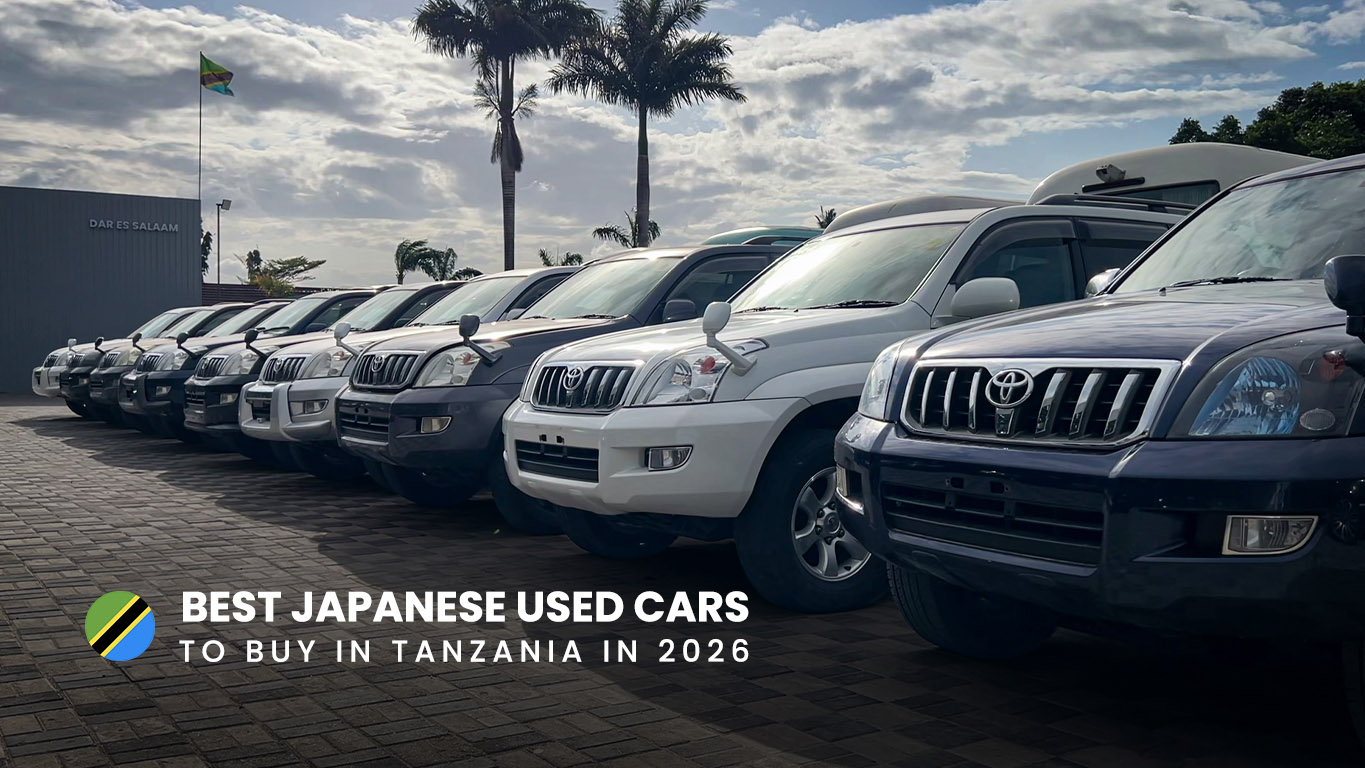
Why 94% of Used Cars in Kenya Come From Japan (And What It Means for Buyers in 2026)

Walk into any car yard in Kenya, check any Facebook marketplace listing, or drive along any highway from Nairobi to Mombasa. The cars you will see are overwhelmingly Japanese. This is not a coincidence. It is the result of a market that has made a very deliberate choice, year after year, based on real-world experience.
Official data published by The East African confirms what every Kenyan driver already knows: Japan accounted for 94.3 percent of the 62,495 used vehicles imported into Kenya in the 12 months to June 2023. That is 58,972 cars from a single country. The UK came second with just 1,921 units. Thailand was third with 1,061.
That gap tells you everything about where Kenyan buyers place their trust. But what is behind those numbers? Why do so many buyers choose Japanese cars specifically, and what does it actually mean for someone looking to buy a used car in Kenya today?
| 94.3% | of Kenya’s used vehicle imports in 2023 came from Japan — official data, The East African |
Kenya’s Used Car Market Is Essentially a Japanese Car Market
The numbers are striking enough that they deserve a moment to sit with. Out of every 100 used cars that entered Kenya in 2023, 94 came from Japan. The remaining six were split between the United Kingdom, Thailand, and everywhere else combined.
This dominance has been building for decades. In 2018, Toyota Motor Corporation alone accounted for just under 60 percent of all motor vehicle sales in Kenya, covering both new and used vehicles. That figure came from official records cited by The East African. Nissan, Honda, and Isuzu made up a significant portion of the rest. Almost all of these came from Japan.
Japanese car brands that have a strong presence in Kenya include Toyota, Honda, Isuzu, Subaru, Mitsubishi, Mazda, and Nissan. Many of these operate through local franchise holders who offer warranties, parts, and servicing. That local infrastructure reinforces buyer confidence in the vehicles themselves.
| Japan | 94.3% share 58,972 units (12 months to June 2023) | UK | 3.1% share 1,921 units (Mainly European brands) | Thailand | 1.7% share 1,061 units (Mainly pickup trucks) |
Source: The East African, official import data, 12 months to June 2023
The Real Reasons Kenyan Buyers Keep Choosing Japanese Cars
Statistics show what happens. They do not always explain why. There are four practical reasons that explain why used Japanese cars have become the default choice for Kenyan buyers across income levels and driving needs.
1. Genuine reliability on roads that punish unreliable cars
Kenya’s roads are demanding. From the potholes of Nairobi’s CBD to the unpaved routes through the Rift Valley, a car that is not mechanically dependable becomes a liability fast. Japanese vehicles, particularly Toyota models, have earned a reputation for surviving those conditions without constant repair bills. That reputation is backed by millions of kilometres of real-world evidence on Kenyan roads.
The Toyota Probox is perhaps the clearest example. The model has been in production since 2002 with minimal design changes because buyers have repeatedly chosen it exactly as it is. It is now found from Nairobi’s traffic jams to the most remote upcountry routes. Its average fuel consumption of around 18km per litre makes it economical for daily use. Spare parts are available in virtually every town in Kenya.
2. Fuel efficiency matters when fuel costs keep rising
With fluctuating fuel prices a constant concern for Kenyan drivers, fuel efficiency is not a nice-to-have feature. It is a financial decision. Japanese vehicles, particularly smaller engine models like the Toyota Vitz (1.0L to 1.5L), Toyota Axio, and Mazda Demio, offer fuel consumption figures in the 18km to 21km per litre range under normal driving conditions. Over a year of daily commuting, that difference adds up significantly against less efficient alternatives.
3. Spare parts are available everywhere in Kenya
Buying a car that you cannot service in your own town is a practical problem. Because Japanese vehicles are so common in Kenya, the spare parts supply chain is well established. Toyota, Nissan, Honda, and Mazda parts are stocked in Nairobi, Mombasa, Kisumu, Nakuru, and most secondary towns. This availability keeps maintenance costs lower and repair turnaround faster than for vehicles with less market penetration.
4. Value for money compared to alternatives
A used Japanese car arriving at Mombasa port after three to five years of careful ownership in Japan often represents better value than a locally used vehicle of the same age. Japanese domestic driving conditions are generally less harsh, service history is more consistently maintained, and odometer readings can be verified through the auction documentation system. Buyers get more car for the same money.
The Toyota Probox, Vitz, Corolla Fielder, and Axio are not popular because of marketing. They are popular because Kenyan buyers have tested them on Kenyan roads and come back for more.
The Most Popular Japanese Cars in Kenya Right Now
While the market covers many brands and models, certain vehicles dominate consistently. These are the models that show up in nearly every car yard and dominate search activity among Kenyan car buyers.
| Toyota Probox | Kenya’s most versatile workhorse. Used by small businesses, families, and taxi services. 18km/l fuel economy. Parts available nationwide. |
| Toyota Vitz | The go-to compact for city driving. 1.0L to 1.5L engines. Fuel consumption of 18.8km to 20.8km per litre. Affordable to buy and maintain. |
| Toyota Corolla Fielder | Popular station wagon with strong resale value. Spacious, reliable, and suited to both city and upcountry routes. |
| Toyota Axio | Lighter than the Fielder with slightly better fuel efficiency. Popular for city commuters and first-time car owners. |
| Nissan Note | A practical supermini that competes on price with Toyota equivalents. Strong popularity particularly in Nairobi. |
| Honda Fit | Reliable, efficient, and well-priced. Known for strong resale value and good interior space relative to its compact exterior. |
What the 8-Year Rule Means for Buyers
Kenya has a specific rule that affects every used car import: vehicles must not be more than eight years old from the year of first registration. This is set by the Kenya Bureau of Standards under KS 1515:2000. In practical terms, a car you import in 2026 must have been first registered in 2016 or later.
This rule exists to protect buyers from very old vehicles and to maintain safety standards on Kenyan roads. All vehicles must also be right-hand drive. Inspection before shipping is mandatory and must be carried out by a KEBS-approved inspection body such as JEVIC (Japan Export Vehicle Inspection Center) or QISJ in Japan.
For buyers, this means that the used Japanese cars arriving in Kenya are relatively recent models, not aging vehicles. A 2018 or 2019 Toyota that has been carefully maintained by its Japanese owner, with full service history and low mileage, represents genuine value.
Questions Kenyan Buyers Ask About Japanese Cars
These are the real questions that come up before someone decides to buy a used Japanese car in Kenya. Straightforward answers only.
| Are Japanese used cars actually reliable or is the mileage often tampered with? |
| Japanese auction vehicles come with inspection reports produced by certified independent inspectors. The mileage is verified and recorded in the report. Odometer tampering is treated seriously by Japan’s auction system, which is why international buyers trust the numbers. A grade 4 and above vehicle from Japan’s auction network has documented, verified mileage. |
| Why are Japanese cars cheaper than equivalent locally used cars in Kenya? |
| Japanese domestic car ownership culture leads to frequent vehicle upgrades, which means relatively young, well-maintained cars enter the auction pool in large numbers. That supply keeps auction prices competitive. By the time a vehicle ships to Kenya and clears customs, it is often still priced competitively against a locally used equivalent of lesser documented condition. |
| How much does it actually cost to import a used Japanese car to Kenya? |
| The landed cost includes the auction or purchase price, shipping (typically KSh 100,000 to KSh 150,000 from Japan to Mombasa), KRA import duty (25% of customs value), excise duty (20% for engines 1500cc and below, 25% above), VAT at 16%, and additional levies including IDF at 3.5% and RDL at 2% of customs value. Port clearing at Mombasa adds approximately KSh 160,000. Use the official KRA duty calculator for an accurate estimate for any specific vehicle. |
| What brands other than Toyota come from Japan? |
| Honda, Nissan, Mazda, Subaru, Mitsubishi, Isuzu, and Suzuki are all well-represented in Kenya’s used Japanese car market. Each brand has its own strengths. Honda Fit is popular for its reliability and resale value. Subaru Forester and Outback are favoured for all-terrain capability. Nissan Note competes strongly with smaller Toyota models on price. |
| Can I trust a Japanese car bought through a dealer in Kenya rather than importing directly? |
| Yes, provided the dealer is verified and transparent. A reputable dealer who sources directly from Japan, shares the original auction inspection reports, and provides full documentation is offering the same vehicle you would get by importing yourself, without the logistics complexity. The key questions to ask any dealer: Can I see the original auction sheet? Are you sourcing directly or through a broker? Is the price breakdown itemized? At Khushi Motors, we have been answering those questions since 2005. |
Why This Matters If You Are Looking to Buy
The dominance of Japanese cars in Kenya is not a trend. It is a settled reality backed by twenty years of buyer behaviour and official import data. When 94.3 percent of a country’s used car market points in one direction, there is genuine substance behind that choice.
If you are considering buying a used car in Kenya, the question is no longer really whether a Japanese car is the right choice. For most buyers, the practical and financial case is clear. The more useful questions are which model suits your needs, what condition you should accept, and where you source it from.
Khushi Motors has been sourcing verified used Japanese cars in Kenya since 2005. Our inventory is inspected before listing, priced transparently, and available for you to browse directly. Every vehicle comes with its original auction documentation.
Also Read: Can You Really Trust Buying a Used Car Online in Kenya?

Brian Otieno
Vehicle Import & Logistics Specialist
Brian specializes in vehicle sourcing from Japan and oversees the import process from auctions to final delivery. He writes detailed guides explaining shipping procedures, customs documentation, taxes, and vehicle import regulations across East Africa.
Ready to Find Your Perfect Car?
Browse our extensive inventory of quality Japanese used cars or contact our team for personalized assistance.