Cars with Low Fuel Consumption in Kenya
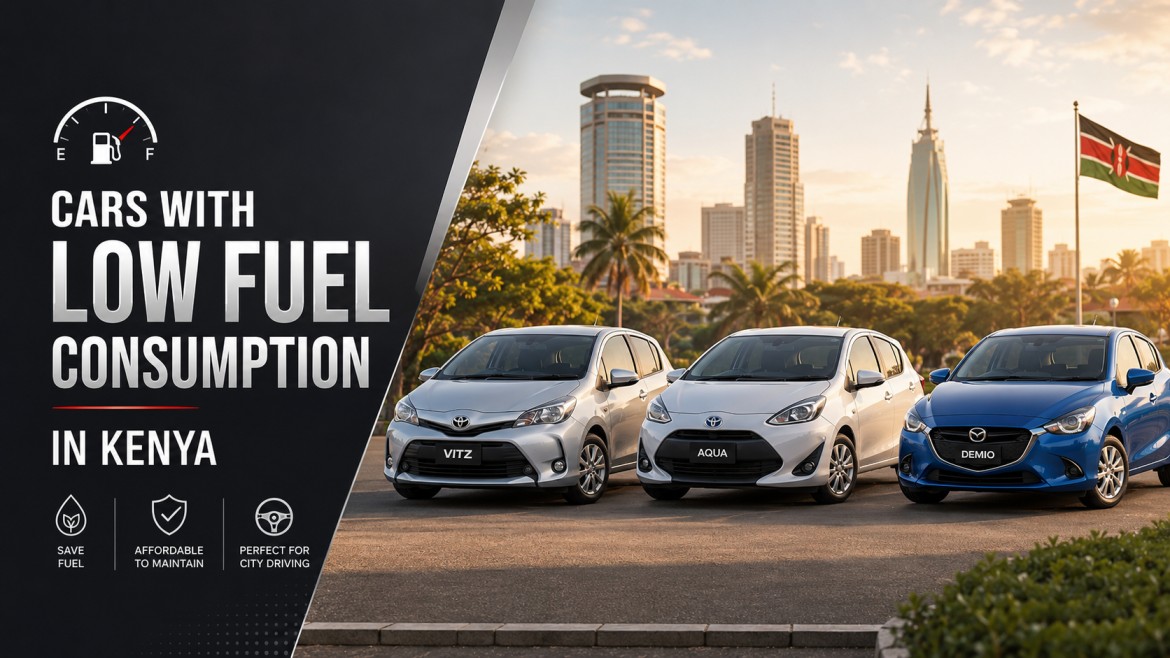
So you are thinking about buying a car and one of the first things on your mind is: how much will it cost me to fuel this thing every month? That is a very smart question to ask, especially with petrol prices in Kenya now regularly exceeding KSh 214 per litre. We have been helping Kenyans buy the right cars since 2009, and as proud KCCI (Kenya Chamber of Commerce and Industry) award winners, one thing we hear from almost every customer is the same concern: "I want something that does not drink petrol." The good news is there are some very good options on the market right now. Cars like the Toyota Aqua, Honda Fit Hybrid, Nissan Note e-Power, Mazda Demio, and Toyota Vitz have real-world petrol figures that will genuinely save you serious money every single month. In this 2026 guide we go through each one honestly, with updated numbers, current Kenya prices, and what to expect on actual Kenyan roads.
Why Fuel Consumption Matters Even More in 2026
The situation is simple. Petrol prices in Kenya have been climbing steadily and your car's fuel economy directly affects how much money stays in your pocket at the end of each month. If you are driving 40 kilometres a day in Nairobi, the difference between a car that gives you 10 km/L and one that gives you 22 km/L could save you well over KSh 200,000 every year. That is real money.
That is why so many buyers specifically looking for low petrol consumption cars in Kenya. You want a car that takes you far on a small amount of petrol. On top of savings, the Kenyan government has also been encouraging the adoption of hybrid and electric vehicles through reduced import duties.
1. Toyota Aqua: The Undisputed King of Fuel Efficiency in Kenya
If someone asks which car uses the least fuel in Kenya in 2026, the Toyota Aqua is still the first name that comes up, and for very good reason. The Toyota Aqua (also known as the Toyota Prius C in some markets) is a full hybrid car, meaning it uses both a petrol engine and an electric motor working together. The official fuel rating is 35.4 km per litre, and real-world owners in Nairobi are now reporting even better numbers, with many averaging 30 to 33 km/L in stop-and-start city traffic specifically because the electric motor handles most of the work when the car slows down or stops.
The Aqua has a 1.5-litre petrol engine paired with Toyota's Hybrid Synergy Drive system and a combined output of 98 horsepower. When you are sitting in traffic on Thika Road or Mombasa Road every morning, the electric motor takes over completely. The petrol engine barely works. That is where you save the most petrol.
Toyota Aqua 2026 Key Numbers
| Official fuel rating: 35.4 km/L |
| Real-world average in Nairobi city traffic: 30 to 33 km/L |
| Engine: 1.5L Hybrid with 98 combined horsepower |
| Price range in Kenya: KSh 800,000 to KSh 2.2 million |
If you are serious about cutting your fuel bill, the Aqua is genuinely hard to beat in 2026. You can browse our current inventory of available units to see what is in stock right now.
2. Honda Fit Hybrid: Maximum Practicality with Excellent Fuel Savings
A lot of people know the Honda Fit as a reliable, affordable small car. But the Honda Fit Hybrid is on a completely different level when it comes to petrol saving and it adds something the Aqua cannot offer: serious interior space. The Honda Fit Hybrid petrol consumption is rated at 36.4 km/L under Japanese test conditions, which made it the most petrol -efficient non-plug-in hybrid car in Japan when it launched. In real Kenyan driving conditions, owners report around 23 to 28 km per litre in combined city and highway use.
The Fit Hybrid uses Honda's i-DCD system, which is a petrol engine working together with an electric motor and a 7-speed dual-clutch gearbox. The Fit also features Honda's famous Magic Seat system, which allows you to fold the rear seats in multiple ways to carry surprisingly large items for a car this size.
Honda Fit Hybrid 2026 Key Numbers
| Official petrol rating: 36.4 km/L |
| Real-world average in Kenya: 23 to 28 km/L |
| Engine: 1.5L Hybrid with 137 combined horsepower |
| Price range in Kenya: KSh 900,000 to KSh 3.2 million |
Even the standard non-hybrid Honda Fit gives you a solid 18 to 20 km/L in normal driving. Our cars collection has Honda Fit options across different price points to match your budget.
3. Nissan Note e-Power: The Closest Thing to an Electric Car Without Plugging In
The Nissan Note is a car that Kenyans love, and the e-Power version is something quite special. Here is how it works: the petrol engine does not drive the wheels at all. It only works as a generator to charge the battery, and the electric motor handles all the actual driving..
Nissan Note fuel consumption in the e-Power version is officially rated at 37.2 km/L, with real-world figures on Kenyan roads running between 24 to 30 km/L depending on how you drive. The latest generation Nissan Note (E13 model from 2020 onwards) also comes with ProPilot driver assistance technology a stronger battery system.
Nissan Note e-Power 2026 Key Numbers
| Official fuel rating: 37.2 km/L |
| Real-world average in Kenya: 24 to 30 km/L |
| Engine: 1.2L e-Power series hybrid system |
| Price range in Kenya: KSh 1.2 million to KSh 2.5 million |
4. Mazda Demio: The Stylish Choice That Does Not Sacrifice Fuel Economy
The Mazda Demio (known as the Mazda2 in some markets) achieves its fuel savings through clever engineering rather than battery technology, specifically through Mazda's SkyActiv system. SkyActiv combines a high-compression ratio engine, a lightweight body structure, careful aerodynamics, and Mazda's i-Stop automatic engine shutdown system. The result is Mazda Demio petrol consumption of around 22 to 25 km/L in real-world driving and an official rating of 24 km/L. For a car with no hybrid system at all, that is genuinely impressive.
Mazda Demio 2026 Key Numbers
| Official fuel rating: 24 km/L |
| Real-world average in Kenya: 22 to 25 km/L |
| Engine: 1.3L SkyActiv with 90 horsepower |
| Price range in Kenya: KSh 700,000 to KSh 1.3 million |
5. Toyota Vitz: Kenya's Most Trusted Everyday Car
Ask any mechanic in Nairobi, Mombasa, or Nakuru which small car they recommend for a first-time buyer, and the answer is almost always the same: Toyota Vitz. Toyota Vitz fuel consumption on the 1000cc engine averages 18 to 22 km/L in real city driving, while the 1300cc version delivers around 20 to 24 km/L and the hybrid variant pushes that further to 20 to 30 km/L. The 1300cc model with the Toyota Stop-Start idling system is officially rated at 26.5 km/L, producing 94 horsepower and paired with a 7-speed Shiftmatic CVT gearbox.
For someone on their first car purchase or anyone who just wants a reliable, daily-use vehicle without worrying about finding a specialist mechanic, the Vitz remains one of the smartest choices in 2026.
Toyota Vitz 2026 Key Numbers
| Real-world km/L: 18 to 22 km/L (1000cc) and 20 to 24 km/L (1300cc) |
| Hybrid variant: 20 to 30 km/L |
| Price range in Kenya: KSh 500,000 to KSh 1.8 million |
| Hybrid models start from around KSh 1.2 million |
You can check our Japan imports if you are looking to import a Vitz directly from Japan at a competitive price.
6. Toyota Passo: Small, Light, and Very Easy on Fuel
The Toyota Passo is one of those cars that does not get much attention but consistently delivers great value. It is one of the lightest cars in the Toyota lineup, and that low weight works directly in your favour when it comes to petrol efficiency. Toyota Passo fuel consumption sits at around 18 to 21 km/L in real-world driving according to 2026 Kenya market data. Prices start from around KSh 400,000 for older models and go up to KSh 1.5 million for newer, cleaner units.
7. Toyota Axio: The Fuel-Efficient Saloon for Families and Professionals
Some buyers need a proper saloon with a proper boot for luggage, more legroom at the back, and a more formal appearance for work or family life. For those buyers, the Toyota Axio (Corolla Axio) is still one of the best choices available in Kenya. The Toyota Axio fuel consumption is around 18.2 km/L for the 1500cc petrol engine and around 15 km/L for the larger 1800cc version. The Axio Hybrid, which shares the same Hybrid Synergy Drive system used in the Toyota Aqua, achieves 25 to 30 km/L, which is remarkable for a saloon car of this size.
Toyota Axio 2026 Key Numbers
| 1500cc petrol: averages around 18.2 km/L |
| 1800cc petrol: averages around 15 km/L |
| Hybrid version: averages 25 to 30 km/L |
| Price range in Kenya: KSh 700,000 to KSh 1.8 million |
8. Suzuki Alto: The Most Affordable Car to Run in Kenya
If you want the absolute cheapest car to run in Kenya then Suzuki Alto is difficult to argue against. It has a tiny 660cc or 800cc engine and that small engine means fuel use is exceptionally low. Suzuki Alto fuel consumption in 2026 is rated at around 22 to 25 km/L in real-world driving, with newer hybrid versions reaching as high as 27 km/L. Current prices in Kenya run from around KSh 380,000 for older models to KSh 800,000 for newer.
Cars Available at Khushi Motors
These low fuel consumption cars are available at Khushi Motors Mombasa. Just choose the car from our listings and let us know we will guide the whole process.
Quick Comparison: 2026 Fuel Consumption for All Cars
| Car | Engine | Real-World km/L (Kenya) | Price Range (KSh) |
| Toyota Aqua Hybrid | 1.5L Hybrid | 30 to 33 km/L | KSh 800K to 2.2M |
| Honda Fit Hybrid | 1.5L Hybrid | 23 to 28 km/L | KSh 900K to 3.2M |
| Nissan Note e-Power | 1.2L e-Power | 24 to 30 km/L | KSh 1.2M to 2.5M |
| Mazda Demio SkyActiv | 1.3L SkyActiv | 22 to 25 km/L | KSh 700K to 1.3M |
| Toyota Vitz 1300cc | 1.3L Petrol | 20 to 24 km/L | KSh 500K to 1.8M |
| Toyota Passo | 1.0 to 1.3L | 18 to 21 km/L | KSh 400K to 1.5M |
| Toyota Axio 1500cc | 1.5L Petrol | 18.2 km/L | KSh 700K to 1.8M |
| Suzuki Alto | 0.66 to 0.8L | 22 to 25 km/L | KSh 380K to 800K |
What Affects Fuel Consumption on Kenyan Roads in 2026?
Even the most fuel-efficient car can use more fuel than expected if certain things are not right. Here are the main factors to keep in mind.
Traffic and driving conditions. Heavy traffic in cities like Nairobi makes all conventional cars use more fuel. Hybrid cars handle this better because the electric motor takes over when the car slows down.
Tyre pressure. Low tyre pressure is one of the biggest and most overlooked causes of high petrol consumption. Check your tyres every two weeks. This alone can improve your fuel economy by 1 to 2 km/L.
Driving style. Sudden acceleration and hard braking waste a significant amount of petrol. Smooth, steady driving, keeping the engine below 3,000 RPM where possible, makes a real difference.
Car maintenance. A dirty air filter, worn spark plugs, or old engine oil all increase fuel consumption. Regular servicing is not optional if you want consistent fuel economy.
Air conditioning use. Air conditioning increases fuel consumption by approximately 1.5 km/L. It is worth turning it off when you do not need it.
Hybrid vs Non-Hybrid: Which Is the Better Choice for Kenya in 2026?
If you mainly drive in city traffic, go hybrid without hesitation. Cars like the Toyota Aqua and Honda Fit Hybrid are specifically designed to shine in stop-and-go conditions. Your monthly fuel saving compared to a conventional car can be tens of thousands of shillings. The Kenyan government's reduced import duties on hybrids also make the entry cost more manageable than it was a few years ago.
If you drive mostly on open highways, a well-engineered non-hybrid like the Mazda Demio SkyActiv or the Toyota Vitz 1300cc can serve you very well. On open roads, the efficiency advantage of a hybrid narrows and the simpler non-hybrid cars are cheaper to buy and easier to maintain.
If you are on a tight budget, the Suzuki Alto and the Toyota Passo give you the lowest running costs combined with the lowest purchase price. You will get a reliable, affordable, economical car that is easy to maintain anywhere in Kenya
Final Thoughts: Find the Right Car for Your Life in 2026
There is no single best car for everyone. What matters is finding the one that fits your driving habits, your budget, and your lifestyle.
If fuel saving is your top priority: the Toyota Aqua is the answer. Real-world owners in Nairobi are seeing 30 to 33 km/L in city traffic. Nothing else at a comparable price comes close.
If you want space plus fuel economy: the Honda Fit Hybrid gives you both in a way that almost no other car at this price can match.
If you want a traditional saloon with low running costs: the Toyota Axio, especially the Hybrid version, is one of the smartest buys in the Kenyan market right now.
If your budget is tight: the Suzuki Alto and Toyota Passo will get you further per litre than almost anything else at that price point.

David Mwangi
Senior Automotive Consultant
David Mwangi has over 10 years of experience in the automotive industry. He specializes in used vehicle evaluations, car buying advice and ownership guidance. His content helps buyers choose reliable vehicles based on budget, fuel economy and long-term maintenance costs.
Ready to Find Your Perfect Car?
Browse our extensive inventory of quality Japanese used cars or contact our team for personalized assistance.