Nissan Note Price in Kenya
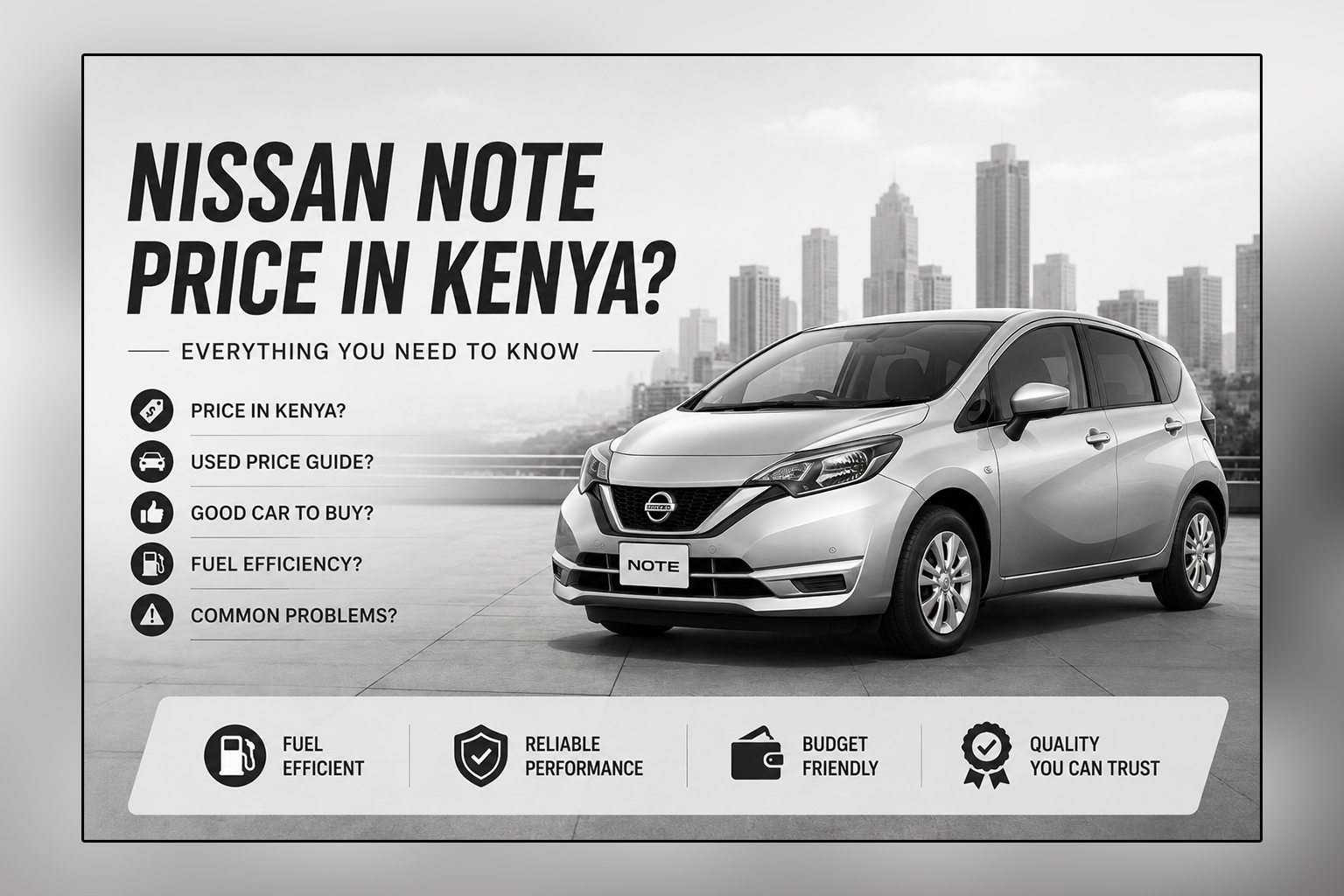
Buying a Nissan Note in Kenya comes down to one question. What should you actually pay? The Nissan Note price in Kenya today sits between KSh 750,000 and KSh 2,500,000. Older locally used units from 2008 to 2012 start around KSh 750,000 to KSh 1000,000. Cleaner 2016 to 2018 imports usually fall between KSh 745,000 and KSh 1.15 million. The e-Power hybrid runs from about KSh 1.1 million to KSh 1.6 million depending on year and mileage. The brand new shape E13 can reach KSh 2.5 million.
Those are real numbers from the Kenyan market. Khushi motors have been selling and importing cars since 2009. We were named Best Car Dealer at the KNCCI Mombasa Business Awards. We see what these cars actually sell for week after week at the port and on the lot.
This guide walks you through every price band. Every engine. The real problems nobody talks about. And exactly what it costs to bring one in yourself.
Nissan Note Price in Kenya: Current Market Rates
Here is what Notes are going for right now.
| Generation and Year | Engine | Typical Price |
| E11 (2008 to 2012) | 1.5L HR15DE petrol | KSh 750,000 to 950,000 |
| E12 (2013 to 2015) | 1.2L HR12DE petrol | KSh 890,000 to 1000,000 |
| E12 facelift (2016 to 2018) | 1.2L HR12DE or HR12DDR | KSh 950,000 to 1,250,000 |
| Note e-Power (2017 to 2019) | 1.2L series hybrid | KSh 1,100,000 to 1,600,000 |
| Note Nismo | 1.2L supercharged | KSh 1000,000 to 1,400,000 |
| Note E13 (new shape) | 1.2L e-Power | Up to KSh 2,500,000 |
Watch out. You will find Notes listed as low as KSh 500,000 on open marketplaces. At that price you are usually looking at a high mileage E11 with tired suspension or an engine that has already been opened.
What Makes the Price Go Up or Down
Six things move the number.
- Year of manufacture. Every year older knocks roughly KSh 50,000 to KSh 80,000 off the asking price.
- Mileage. A 2016 Note with 60,000 km will cost KSh 150,000 more than the same car with 140,000 km.
- Local unit or fresh import. A fresh import from Japan carries a premium of about KSh 100,000 to KSh 200,000. The trade off is verified mileage and a car that never sat in Nairobi traffic for eight years.
- Grade. e-Power costs more than petrol. Nismo costs more than standard. A car with a reverse camera and push start will always ask higher.
- Original paint. This is a very Kenyan thing. Original paint adds real value here. Resprayed panels usually mean an accident.
- Engine size. The 1500cc E11 attracts different duty from the 1200cc E12. That feeds straight into the import cost.
Nissan Note Variants and Engines Explained
Not every Note is the same car. Know what you are buying.
E11 (2005 to 2012)
The first shape. Bigger 1.5 litre HR15DE petrol engine. Simple and cheap to fix. Parts are everywhere in Kenya. Fuel economy is around 12 to 14 km per litre in town. Not great by modern standards but the car is honest.
E12 (2012 to 2020)
The one most Kenyans own. Nissan dropped to a 1.2 litre three cylinder HR12DE engine. Smaller and lighter. Better fuel economy at around 16 to 18 km per litre. Higher grades got the HR12DDR which is supercharged and gives you more push on the Mombasa Road climb.
Note Nismo
A sportier E12. Bucket seats. Firmer suspension. Body kit. Usually supercharged. Fun to drive but the ride is hard on Kenyan roads and the low bumper will meet every bump you own.
Note e-Power
This is the interesting one. The e-Power is a series hybrid. The petrol engine never drives the wheels. It only charges a battery. An electric motor turns the wheels.
You do not plug it in. You just put petrol in it and drive.
The result is very smooth power delivery and real world figures of about 25 to 30 km per litre in city traffic. In Nairobi stop and go this is genuinely impressive. Nissan quotes higher numbers in Japan. Ignore those. Kenyan traffic and Kenyan fuel give you real world results.
Note E13
The newest shape. Only sold as e-Power. Better interior. More driver assistance. Expensive. Most units in Kenya are very fresh imports and prices climb toward KSh 2.5 million.
Nissan Note vs Rivals: Honda Fit, Mazda Demio and Toyota Vitz
These four fight for the same shilling. Here is an honest comparison.
| Features | Nissan Note | Honda Fit | Mazda Demio | Toyota Vitz |
| Price range | KSh 450k to 1.6M | KSh 550k to 1.5M | KSh 500k to 1.2M | KSh 450k to 1.1M |
| Engine | 1.2L or 1.5L | 1.3L or 1.5L | 1.3L or 1.5L | 1.0L to 1.5L |
| Fuel economy | 16 to 18 km/L | 17 to 20 km/L | 18 to 20 km/L | 17 to 19 km/L |
| Boot space | Best in class | Very good | Small | Small |
| Rear legroom | Excellent | Excellent | Tight | Tight |
| Parts availability | Good | Fair | Fair | Excellent |
| Resale value | Good | Good | Fair | Excellent |
| Hybrid option | e-Power | Fit Hybrid | None common | Vitz Hybrid |
The Honda Fit is the closest rival on space. But Fit CVT gearboxes have a worse reputation here than Nissan CVTs and Honda parts cost more.
You can compare these against the cars we have on sale in Kenya right now to see how the numbers hold up on real stock.
Is the Nissan Note a Good Car to Buy in Kenya?
Yes, for most buyers. But not for everyone.
- Buy it if you drive mainly in town. You want space without paying saloon money. You do Uber or Bolt and fuel cost matters. You have a small family.
- Do not buy it if you regularly drive rough upcountry roads. Ground clearance is about 150 mm. That is fine for tarmac and light murram. It is not fine for deep ruts.
- Think twice if you plan to keep the car for ten years and do very high mileage. The CVT gearbox is the weak point and we say that as people who sell these cars.
The Note is comfortable. It is cheap to run. It holds its value reasonably. For a Nairobi commuter or a ride hailing driver it is one of the smartest buys on the market.
Common Problems With the Nissan Note
Every dealer tells you the good parts. Here are the bad ones.
| Problem | What happens | What it costs you |
| CVT gearbox | Fails if oil is never changed. Change it every 40,000 km. | KSh 150,000 to 250,000 to replace |
| e-Power battery | Expensive to replace. Few specialists outside Nairobi and Mombasa. | Check battery health before you pay |
| Suspension bushes | Kenyan roads eat them faster than the manual says. | Routine, but budget for it early |
| Water pump and thermostat | Common wear item on the HR12 engine. | Moderate |
| Three cylinder vibration | Slight shake at idle on the 1.2 litre. | Nothing. This is normal, not a fault. |
| Parts network | Widely available but thinner than Toyota in small towns. | A day or two of waiting |
None of this makes the Note a bad car. It makes it a car you must service properly.
How to Import a Nissan Note to Kenya
Importing yourself can save money. It can also cost you money if you get it wrong. Here is the process.
Step 1: Check the age rule
Kenya does not allow vehicles older than eight years from year of manufacture. In 2026 this means the car must be a 2019 model or newer. There is no exception. A 2018 Note cannot be imported in 2026 no matter how clean it is.
Step 2: Buy from a verified exporter
Japan is the main source. Use an exporter that gives you an auction sheet and a chassis number you can verify.
Step 3: Pre shipment inspection
A KEBS approved agent must inspect the car before it leaves Japan. Agents include QISJ, JEVIC and EAA. This costs roughly USD 150 to USD 250. Without this certificate the car cannot be cleared.
Step 4: Shipping
Mombasa port handles most vehicle imports. Sailing time is around four to six weeks. Buy marine insurance.
Step 5: Clearing
A licensed clearing agent handles customs. You will need the invoice, bill of lading, logbook from Japan, inspection certificate and your KRA PIN.
Step 6: NTSA registration
Once duty is paid you register with NTSA and get plates. Total time from order to plates is usually three to five months. Read more about importing cars into Kenya before you commit money.
Nissan Note Import Cost in Kenya
Taxes are charged in a cascade. Each tax feeds the next.
KRA takes the Current Retail Selling Price of the car. It applies depreciation based on age. That gives the customs value. Then:
| Tax | Rate | Applied to |
| Import Duty | 25% | Customs value |
| Excise Duty | 20% (under 1500cc petrol) | Customs value plus import duty |
| VAT | 16% | Customs value plus import duty plus excise |
| IDF | 3.5% | Customs value |
| RDL | 2% | Customs value |
Worked example
Say a Nissan Note has a depreciated customs value of KSh 700,000.
| Item | Amount |
| Import Duty | KSh 175,000 |
| Excise Duty | KSh 175,000 |
| VAT | KSh 168,000 |
| IDF | KSh 24,500 |
| RDL | KSh 14,000 |
| Total taxes | KSh 556,500 |
On top of that you pay clearing costs at Mombasa. Port charges, SGR, verification, Interpol check, radiation check and the NTSA sticker come to around KSh 160,000.
So budget roughly KSh 700,000 in taxes and clearing before you even count the purchase price and the freight.
Financing Your Nissan Note
Most Kenyans do not pay cash. Here are the real options.
- Bank asset finance. Banks such as Stanbic, Absa, KCB and Equity finance used cars. Expect a deposit of 20 to 30 percent. Terms run 36 to 60 months. The car must usually be under eight years old at the end of the loan.
- Sacco loans. Often cheaper than banks. You need to be a member with savings history. Many Kenyan buyers use this route.
- Dealer financing. Some dealers accept a deposit and monthly instalments. Read the terms carefully. Interest is sometimes buried in the price.
- Logbook loans. Avoid unless you have no choice. Rates are high.
Nissan Note Available at Khushi Motors
We keep a rotating stock of Notes across all grades. Petrol E12 units, e-Power hybrids and the occasional Nismo.
Every unit we sell comes with verifiable mileage, a full inspection report and clean transfer documents. If we do not have the exact grade or colour you want, we will import it for you to your specification.
If you are still weighing your options, our guide on Nissan fuel consumption covers more details related to fuel consumption and costs.
Frequently Asked Questions
Is the Nissan Note a good car to buy in Kenya?
Yes for city drivers and ride hailing operators. It offers strong fuel economy, generous rear legroom and low running costs. It is less suited to rough upcountry roads because ground clearance is only about 150 mm. Service the CVT gearbox regularly and it will last.
What are the common problems with the Nissan Note?
The CVT gearbox is the main weakness and fails if oil is never changed. Other issues include suspension bush wear on rough roads, water pump failure and costly e-Power battery replacement. Three cylinder idle vibration is normal and not a fault.
What is the average price range for a compact hatchback car in Kenya?
Compact hatchbacks in Kenya generally cost between KSh 450,000 and KSh 1,600,000. Older locally used units sit at the bottom. Fresh imports and hybrid models sit at the top. Brand new units can exceed KSh 2,500,000 depending on grade and specification.
What is the current market price range for a used compact Japanese hatchback in Kenya?
Used Japanese hatchbacks such as the Note, Fit, Demio and Vitz typically range from KSh 450,000 to KSh 1,200,000. Price depends on year, mileage, original paint and whether the unit is locally used or a fresh import from Japan.
What are the typical financing options for purchasing an imported compact vehicle?
Bank asset finance is the most common option and needs a deposit of 20 to 30 percent over 36 to 60 months. Sacco loans often carry lower rates for members. Dealer instalment plans are also available. Avoid logbook loans where possible.

David Mwangi
Senior Automotive Consultant
David Mwangi has over 10 years of experience in the automotive industry. He specializes in used vehicle evaluations, car buying advice and ownership guidance. His content helps buyers choose reliable vehicles based on budget, fuel economy and long-term maintenance costs.
Ready to Find Your Perfect Car?
Browse our extensive inventory of quality Japanese used cars or contact our team for personalized assistance.